The United States in 1784

“I want to vent myself … “

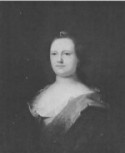
Christian Barnes, the wife of a colonial businessman, wrote to a friend in Scotland in 1769 of escalating unrest in the Boston area.

… It is long since I have dabled in Politicks, and sorry I am to resume the subject. … nor would I now trouble you with it but that I want to vent myself, and … ‘To whom shall I complain if not to you?’  The Spirit of discord and confusion which has prevail’d with so much violence in Boston has now begun to spread it self into the country. These Poor deluded People with whom we have lived so long in Peice & harmony have been influenced by the Sons of Rapin to take every method to distress us. … The first thing that fell a Sacrifice to their mallace and reveng was the Coach, which caused so much decention between us. This they took the cushings out of and put them in the Brook, and the next night Cut the Carraig to peices. Not long after they Broke the Windows at the Pearl Ash Works. …

The greatest loss we have as yet met with was by a mob in Boston, who, a few Nights ago, atacked a wagon Load of goods which belong’d to us. They abused the Driver, and cut a Bag of Pepper, which contain’d three hundred pd, leting it all into the street; then gather’d it up in their Hand[kerchie]fs & Hatts, and carried it off.

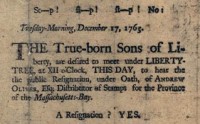
This excerpt is from In the Words of Women, Chapter 1, pages 14-15.

posted January 30th, 2012 by Janet, Comments Off on “I want to vent myself … “, CATEGORIES: Boston, Looting, Loyalists, Violence

“O how I despise such men”

Because the Seven Years War (1756-1763) had seriously depleted British coffers, the government of George III sought to raise money for “defraying the expenses of defending, protecting and securing” America. (That part of the war fought in the colonies was called the French and Indian War.) One attempt was the Stamp Act of 1765, which imposed a direct tax on such items as bills of lading, playing cards, dice, marriage licenses, and newspapers. Paper with watermarked stamps had to be used for legal documents. Protests throughout the colonies were many and often violent: stamp agents were tarred and feathered, officials were hanged in effigy. Many were forced to resign.

Deborah Read Rogers Franklin, the wife of Benjamin Franklin, had not accompanied her husband to England, where he had gone to represent Pennsylvania’s interests. In this letter to Benjamin she provided news about the reaction to the Stamp Act. (As Deborah’s idiosyncratic spelling is frequently difficult to decipher, only the first paragraph has been kept as written. It’s best to read it out loud.) She addressed her husband as “my dear child.”

[Philadelphia] Feb the 10, [1765]I am set down to Confab a littel with my dear child as it Semes a Sorte of a hollow day for we have an ox arosteing on the [Delaware] river and moste pepel semes plesd with the a fair but as I partake of none of the divershons I stay at home and flatter myselef that the next packit [boat] will bring me a letter from you. … [Oct. 8-13, 1765]My Dear Child
I have been to see Mr. Hughes [the designated stamp distributor] who I found a little better and able to stir himself which I know will give you pleasure and the more so as you will hear no doubt how he has been used and by men that better things might be expected from. First to have the bells muffled and send two Drums about the town to raise the mob, and send them under Mr. Hughes’ window; then send messengers to tell him that they was a Coming and would be there in a minute and almost terrify his wife and Children to death; and after this, the man who was at the head of their affair to Complement himself with the merit of preventing the mob from falling on and destroying Mr. Hughes and his whole family. … O how I despise such men.

Yesterday I put on board of Capt. Friend the same bail [bucket] that you sent to us filled with Cranberries. I Could not get as many as would fill a Barrel nor I Could not get a half Barrel … I hope they will keep. … I thank you for the worsted, the Sugar nippers, and the muslin for my apron, and for the Curtains. I think them very handsome. …
as ever yours till DeathD Franklin

The excerpts are from In the Words of Women Chapter 1, pages 4-6. The Stamp Act can be seen in an exhibition at The New-York Historical Society called “Revolution! The Atlantic World Reborn.” It is on loan from the Parliamentary Archives, London, and is displayed for the first time outside the U.K. The portrait is by Benjamin Wilson ca. 1758-59.

posted January 26th, 2012 by Janet, Comments Off on “O how I despise such men”, CATEGORIES: Philadelphia, Resistance to British, Violence

“I have so much to learn”

By the 1790s, it was considered acceptable for girls from well-to-do families to attend female seminaries. Margaretta Ackerly was enrolled in the Moravian Female Seminary in Bethlehem, Pennsylvania, noted for a rigorous curriculum that included reading, writing, arithmetic, German, English, history, geography, religion, music, and, of course, instruction in the feminine skills of sewing and knitting. As Margaretta explained to her sister in New York City, she had much studying to do.

I shall not have time to write more than this letter to you and this must be shortened, for oh if you only knew what I have to do, our examination commences this day a week. And I have so much to learn I dont know what to do with myself I hardly know what I write I think of nothing only what I have to learn, this morning I was up at 4 oClock sitting by the Lamp studying & every night I have 3 or 4 books under my head. …

In a later letter, as college students through the ages have done, Margaretta asked for a number of things to be sent to her.

You wish to know what things I shall want this summer, I shall send you a list. … Present my duty to my beloved Parents tell them though it is very seldom I write to them yet I often think of them with the sincerest affection. …
Your ever loving & Sincere sister M. Akerly

You will please to send me
1 white & 1 Light Calico frock
2 pair of stockings, garters
A stiff petticoat blue
2 vandykes*
2 pair pockets**
cap ribbon
tooth brush
a little ribbon for a hat, & vail
a skein of white & black silk Green
a white short gown
any thing else you chuse

* Vandycks were collars or kerchiefs made of lace and linen characterized by deeply cut, pointy edges.
** In the eighteenth century, pockets were not built into women’s clothing as they are today. Instead there were separate pockets that could be tied on and removed, much like an apron. They could be worn over skirts or underneath, with slits in the skirt to provide access. Try making a pair.

The first excerpt is from In the Words of Women, Chapter 8, page 232. The second excerpt is from The New-York Historical Society. Misc. Mss. Akerly.

posted January 23rd, 2012 by Janet, Comments Off on “I have so much to learn”, CATEGORIES: Education, Fashion, Letter-writing

“Women are always usful in grand Events”

Patience Lovell Wright, a Quaker widow, was famous for her lifelike sculptures made of wax. In 1772, she traveled to England, where her first sitter was her compatriot Benjamin Franklin. She made portrait busts of other “eminent Personages” including the historian Catharine Macaulay, King George III, and Queen Charlotte, modeling the figures on her lap while engaging her sitters in conversation. Moving in London’s high society, Wright thought herself in a unique position to gather “Early Intelegenc and a few Hints” for the Americans, as she wrote her friend John Dickinson:

Pallmall april 6th 1775SirThe fleat is any moment to sail and a new Constructed Cannon, lite, Portable on horse Back, 32 Inches Long, wide muzzel to fire at the Inhabitants and kill many at a shot. Meny thousand fire arms sent out of the tower and shipt on bord the transports at dedford. Meny hundred Cags [kegs] of flints marked BOSTON on Each Cagg with all Implements of WARR. But this is all well known to you in america. I much wish to asist you in giving you the Early Intelegenc and a few Hints may be usful. …

Howe is to land at new york. The Delancy Breed* is married in England and, by that means the names of the inhabitan in new york are Known to the ministry and they Expect to bribe them with Contacts and Places and ther port left open to devide the Coloneys and to deceve the peopl, But I depend on the Vertue of the Peopel. …

I am hapy to live in the days when I see with my own Eyes, I here with my own Ears, and Know the wicked Counsel that is against you, as also to be so Hapy to Know meny of the gentlemen in the Congress and am not a silent spectatr on the grand works of provedenc. … By good authority I write you this. Women are always usful in grand Events. …

Take this Hint from your old friend and devotd humbl srvt Patience Wright

* the DeLancey family of New York

This excerpt is from In the Words of Women, Chapter 4, pages 93-94. The anonymous engraving is from the London Magazine, December 1, 1775, The Library of Congress, Washington, D.C.

posted January 19th, 2012 by Janet, Comments Off on “Women are always usful in grand Events”, CATEGORIES: Americans Abroad, Patriots, Spies

“… the recollection that I had once had tender parents …”

Mary Jemison lived on a farm near Gettysburg, Pennsylvania, with her parents and siblings, when a raiding party of six Indians and four Frenchmen took them captive on April 5, 1758. Though her two elder brothers were able to escape, her parents and the other children were killed; twelve-year-old Mary was carried off down the Ohio River to a Seneca Indian town. Indians usually took prisoners for a purpose: to use for ransom, to frighten encroaching settlers, or to take the place of a slain relative.
Mary Jemison’s story belongs to a genre known as “capitivity narratives,” in her case as told to Dr. James F. Seaver in central New York State, where Mary lived in her declining years. It was published in 1824 and, contrary to other accounts of captivity, it conveys a fairly positive view of Indians, their culture, and way of life.

It was my happy lot to be accepted for adoption. At the time of the ceremony I was received by the two squaws to supply the place of their brother in the family; and I was ever considered and treated by them as a real sister, the same as though I had been born of their mother. … I was employed in nursing the children, and doing light work about the house. Occasionally, I was sent out with the Indian hunters, when they went but a short distance, to help them carry their game. My situation was easy; I had no particular hardship to endure. …

My sisters were diligent in teaching me their language, and to their great satisfaction, I soon learned so that I could understand it readily, and speak it fluently. I was very fortunate in falling into their hands; for they were kind good natured women; peaceable and mild in their dispositions; temperate and decent in their habits, and very tender and gentle toward me. …

The town where they lived was pleasantly situated on the Ohio, at the mouth of the Shenanjee. The land produced good corn, the woods furnished a plenty of game, and the waters abounded with fish. We spent the summer at that place, where we planted, hoed, and harvested a large crop of corn, of an excellent quality. …

continue reading…

posted January 16th, 2012 by Janet, comments (1), CATEGORIES: Indians

next page

   Copyright © 2026 In the Words of Women.