The United States in 1784

“a Globe of Montgolfiers went up … “

I can’t help myself. I must include additional posts on Sarah Jay that give further credence to to my view that she is one of the most interesting and intelligent wives of the Founding Fathers.

Next Tuesday, June 4, will be the 230th anniversary of the first public demonstration of a hot air balloon conceived and constructed by the Montgolfier brothers, Joseph and Etienne. In September of 1783, a balloon carrying a duck, a rooster, and a sheep rose into the air before Louis XVI and his court at Versailles. Sarah Jay was in Paris at this time with her husband who, along with Benjamin Franklin, John Adams, and Henry Laurens, had been negotiating the terms of the treaty of peace with the British. After the Preliminary Articles were completed, John went to Bath, England, seeking relief from his various physical ailments. Remaining in Paris with their two little girls, Sarah witnessed two balloon ascents: a manned, untethered flight of the Montgolfier hot air balloon and another on December 1, by a competitor Jacques Charles, filled with inflammable hydrogen. She informed John on November 27 that

a Globe of Montgolfiers went up the other day from the Muette* with two persons in a gallery that was fix’d to it: after the cord that detain’d it was cut, it asscended three thousand feet high, & the gentlemen that were attach’d to it, observing at one time that it descended rather to rapidly, threw into it [a fire] a little more straw, & then it again mounted, by which means they remained in the air ‘till they had gone from the place from whence they set out to Paris, pass’d over the whole City, ‘till at length concluding they had stay’d as long as the experiment required, suffered themselves to descend gradually near the Boulevards, without having expended more than a third part of the straw they had provided. Next Saturday Monsr. Charles will entertain the public wh. a like experiment of a Globe fill’d wh. inflammable Air.
Don’t you begin to think of taking yr. passage next Spring in a Ballon?

* Royal Cháteau La Muette on the edge of the Bois de Boulogne.

The quoted passage appears in the Selected Letters of John Jay and Sarah Livingston Jay, page 154. The illustration is a model of the Montgolfier balloon at the Science Museum in London.

posted May 30th, 2013 by Janet, Comments Off on “a Globe of Montgolfiers went up … “, CATEGORIES: Americans Abroad, Amusements, Paris

“mills for making sugar”

When the voyage resumed, Sarah Jay once again took pen in hand on the “Aurora frigate, sailing sweetly before the wind, Jany. the 9th, 1780,” this time to write to her father-in-law about sugar making in Martinique. Her clear description of the process is evidence of her intelligence, powers of observation, and writing skill.

The climate was not disagreeable at the time we were there, tho’ we could have dispensed with a few rays of the Sun, had they been disposed to visit you in your retirement. …

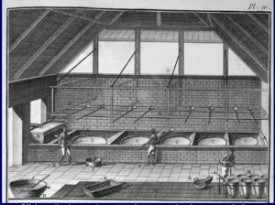
Having mentioned the cane, perhaps Peter [John Jay’s brother] may be curious to know the construction of the mills for making sugar. … I think it very like those we have for cyder, only that the rollers are of iron & the reservoirs for the Juice directly under the rollers. The wheel is turned by another wheel, which receives its motion from a stream of water; the juice is conducted from the reservoir, that immediately receives it to a large bason by a gutter, and from thence by the same kind of conveyance into a large boiler.

When it has considerably boiled away, it is then put into the next of a smaller size, & again when diminished to a certain quantity put into the third & last, to which they then pay a great attention, throwing it up continually with a large flat shovel to prevent it from burning, & when it attains a consistency the syrup is poured into large earthen pans in the form of sugar loaves with holes in the bottom which they stop till the sugar begins to chrystallize, then unstopping them, they are set in jars & the syrup that contains no grain drains off, & is what we call molasses.

She closed the letter with the hope that the difficulties the Jays had to deal with in wartime would soon come to an end.

Adieu, my dear sir, may tranquil days and peaceful slumbers soon succeed to those stormy & restless ones that unfortunately have disturbed your repose, & may no anxious cares invade your bosom for the safety of your children, in the number of whom its my pleasure & pride that you acknowledge your truly affecte. daughter Sa. Jay

The image of a water-powered mill is from Denis Diderot, Encyclopédie, ou, Dictionnaire Raisonné des Sciences, des Arts et des Metiers … Recueil de Planches, sur les Sciences … (Paris, 1762), vol. 1, plate II, figs. 1 and 2. (Special Collections Department, University of Virginia Library) The source for the illustration of the boiling room is the same as above, plate IV. The illustration shows slaves at work in the processing of sugar. On the left is the tank that receives the cane juice flowing from the mill where the sugar cane has been crushed and the juice extracted. In the center are the copper cauldrons in which the sugar juice is boiled, with slaves moving the crystallized sugar from one to the other with giant ladles. On the lower right are the conical sugar pots into which the raw sugar will be placed and then taken to the curing house to drain out the molasses. Sarah’s letter appears in Selected Letters of John Jay and Sarah Livingston Jay on pages 72-73.

posted May 27th, 2013 by Janet, Comments Off on “mills for making sugar”, CATEGORIES: Food, Letter-writing, Travel

“every thing almost having an air of novelty to me … “

After some weeks the disabled frigate Confederacy, whose troubles were described in the previous post, caught the trade winds which blew it directly toward the island of Martinique, which was called Martinico at that time. Sarah wrote of her pleasure at seeing land once again. “On the 18th inst. early in the morning I was most agreeably surprised to find, that we were sailing close along the [shore of the] most verdant, romantic country I ever beheld. In that instant, every disagreeable sensation rising from unpleasing circumstances during our voyage, gave place to the more mild & delightful emotions of gratitude. …” During the short stay while arrangements were made to transfer to a small French frigate which would carry the passengers to Europe, Sarah Jay took the opportunity to describe the island in a letter she wrote to her father, emphasizing subjects she knew he would be interested in.

The first approach to Martinico is extremely beautiful: tho’ the grounds are vastly uneven they do not appear like the unfinish’d work of nature, but rather as if in a sportive humour she had display’d a whimsical fancy. It is not more than sixty miles in length & therefore the inhabitants have found their advantage in cultivating every part of it: you can hardly imagine how romantic an appearance the whole Island offers. … The heights and plains (or rather the intervals between the hills) are equally verdant, and it is really surprising to trace the effects of industry on the very summits of the hills which are all covered with coffee, coconuts and cane: every here and there the eye is surpris’d [by] settlements aside & amid the hills belonging to the negros who are employed upon the plantations. Then again a plain of small extent with genteel houses diversify the prospect: but nothing in my opinion has a more pleasing effect upon the sight than the falls of water that come tumbling down, murmuring as they roll over projecting rocks & broken grounds.

St. Pierres is the capital of the Island and a very pretty city it is: directly behind the town a fine river descends from the mountains [which] waters the city in a most delightful manner, through each street there runs a small stream that cools & cleanses them at the same time, and every inhabitant that chooses may have a sufficiency of water admitted into their dairies and rooms for bathing. The bathing rooms of the gentlemen are really very elegant as well as convenient: they have by a very simple contrivance the advantage of warm as well as cold baths, both of which are very useful as well as agreeable in that warm country, and I’m told that one or the other serve as a remedy for almost every Disorder incident to the climate: so that you may suppose phisicians there are rare. …

I was very sorry that the shortness of my stay … prevented me from making as many observations as we were invited by our situation, every thing almost having an air of novelty to me. … A Gentleman was so obliging as to have some cane gathered tho’ out of season on purpose to gratify our curiosity by shewing us the process of making sugar.

It was some satisfaction to me to distinguish for myself in what manner the Coffee grows as I received very different accounts from different persons: the grain is inclosed in red berries that grow upon trees resembling our cherry trees the leaves of which are not unlike those of our peach and the trees would be equally tall were they not trimmed but those who cultivate them find that by keeping them low they spread and produce more. As cotton is rais’d in America it’s needless to say any thing of that tho’ the manner in which it’s produc’d was new to me. …

You would be pleased with the variety of fish they have at Martinico, which they dress extremely well as indeed they do every thing that appears upon table. Crabs I did not see: their lobster tho’ different in shape from those in our part of America, are nevertheless excellent. I can’t say much for the oysters, they grow upon trees in the water. … They have a small shell fish call’d crevisse that are very sweet and exactly resembles in shape our lobsters; they are larger than shrimps, and tho’ seldom served upon table when they exceed three or four inches in length, I am told they would, if left to mature attain the size of lobsters.

If I have too long detain’d your attention from subjects more interesting than those of my letter, I’m sure you’ll pardon me … the intention … was to amuse you and entertain myself for while writing to you I’m flatter[ed] with an idea of being in your company and so pleasing to me is that illusion that it’s with reluctance I quit it even to assure you that I am my dear papa
Your very affectionate and dutiful daughter

Quoted material appears on pages 70-72 of Selected Letters of John Jay and Sarah Livingston Jay.

posted May 23rd, 2013 by Janet, Comments Off on “every thing almost having an air of novelty to me … “, CATEGORIES: Food, Letter-writing, Travel

“… tossd about in the midst of the Ocean …”


In the previous post Sarah Jay wrote to her mother praising her husband and his behavior on board the Confederacy, a 36-gun frigate, as they sailed to Spain in 1779 where John was to be minister plenipotentiary. Winter voyages across the Atlantic were especially perilous. Sarah describes to her mother what happened to their vessel.

We embark’d at Chester on the 20th of Octbr., but did not lose Sight of land ‘till the 26th:, when we launch’d out to Sea with a brisk gale. The very first evening we were all Seized with the most disagreeable Sickness peculiar to our Situation. …

About 4 o’clock in the morning of the 7th of November, we were alarmed by an unusual noise upon deck, & what particularly surpris’d me, was the lamentations of persons in distress. I call’d upon the Captn. to inform me of the cause of the confusion that I imagined to prevail, but my Brother desir’d me to remain perfectly composed, for that he had been upon deck but an half an hour before & left every thing in perfect security.

Perfect security! Vain words! Don’t you think so Mamma? And so indeed they prov’d. For in that small space of time we had been depriv’d of nothing less than our bow sprit, fore mast, main mast, & missen mast; so that we were in an awkward situation rendered still more so by a pretty high South-East wind & a very rough sea that prevail’d then: however our misfortunes were only began, the injury receiv’d by our rudder, the next morning, served to compleat them as we were ready to conclude. …

Will it not be painful to my dear Mamma to image to herself the situation of her children at that time? Her children did I say? Rather let my benevolent Mamma imagine the dangerous situation of more than 300 souls toss’d about in the midst of the Ocean, in a Vessel dismasted & under no Command, at a season too that threatened approaching inclemency of weather. …

After our misfortunes on the 7th & 8th of November … a Council of the Officers was held to consider where it was most expedient to bend our course & it was unanimously concluded by them that it wou’d be impossible to reach Europe at this season, with a ship in the condition that ours was. They were likewise united in opinion that the southern direction was the only one that offered a prospect of safety, & of the Islands, Martinico was the most eligible, for its commodious harbour & the probability of being supplied with Materials to refit.

The excerpt is from Selected letters of John Jay and Sarah Livingston Jay pages 65-66. The painting depicting the Continental Navy frigate Confederacy is displayed at the Navy Art Gallery at the Washington Navy Yard.

posted May 20th, 2013 by Janet, Comments Off on “… tossd about in the midst of the Ocean …”, CATEGORIES: Ocean Voyages, Weather

” … his modesty is equal to his merit”

Sarah Van Brugh Livingston and John Jay were married on April 28, 1774 at her father’s home in New Jersey called Liberty Hall. The talented young lawyer was twenty-nine and Sarah was eighteen. It was a love match. Although John became what might be called a reluctant revolutionary, once he committed to the American cause he never wavered. He held several posts in the emerging governments on both state and national levels. After serving as president of the Continental Congress, Jay was named minister plenipotentiary to Spain in 1779. Sarah determined to accompany him on his diplomatic mission—a brave undertaking—leaving their young son Peter Augustus with her family. Great difficulties were encountered on their sea voyage. More on this in a later post.

While it was normal for young married women to sing the praises of their husbands, you will, I think, agree that Sarah, known as Sally, took adulation to a new level. Read what she wrote to her mother Susannah French Livingston from the ship Confederacy in December 1779. Keep in mind that wives often referred to their husbands as “friends.”

Your whole family love Mr. Jay, but you are not acquainted with half his worth, nor indeed are any of his friends, for his modesty is equal to his merit. It is the property of a Diamond (I’ve been told) to appear most brilliant in the dark; and surely a good man never shines to greater advantage than [in] the gloomy hour of adversity: in scenes of that kind I have lately beheld with pleasure, & even admiration, the firmness & serenity of mind that evidently shone out in the countenance of our invaluable friend. May he long, very long, be preserved a blessing to his connections & a useful as well as disinterested friend to his Country. Pardon me Mamma, if I appear to prolix in the praises of the person we so highly love & esteem. Am I not writing to a partial mother? And is it not a consolation to her, that the guardian of her children is worthy of her confidence? Besides, I have the pleasure to hope that none but friendly eyes will peruse this scrawl, & I therefore indulge myself as though I were actually conversing with my dear family friends: I hope every letter I receive from them will be equally free from restraint.

The quoted paragraph appears in Selected Letters of John Jay and Sarah Livingston Jay, compiled and edited by Landa M. Freeman, Louise V. North, and Janet M. Wedge (Jefferson, North Carolina: McFarland & Company, 2005) page 66.

posted May 16th, 2013 by Janet, Comments Off on ” … his modesty is equal to his merit”, CATEGORIES: Marriage, Ocean Voyages

next page

   Copyright © 2025 In the Words of Women.