The United States in 1784

I Was snatchd from Africs fancyd happy seat

When William Legge, Earl of Dartmouth, was appointed Secretary of State for the American Department by King George III in 1772, many hoped he would be sympathetic to America’s grievances and that war could be averted. Phillis Wheatley had met him while in London to promote her book and wrote a poem addressed to him in which she expressed the hope that British policy—”wanton Tyranny”—toward the American colonies would change and described from whence her love of freedom derived.

To the Right Honourable William, Earl of Dartmouth

Hail, happy day, when, smiling like the morn,
Fair Freedom rose New-England to adorn:
The northern clime beneath her genial ray,
Dartmouth, congratulates thy blissful sway:
Elate with hope her race no longer mourns,
Each soul expands, each grateful bosom burns,
While in thine hand with pleasure we behold
The silken reins, and Freedom’s charms unfold.
. . . . . . . . . . . . . . . . . . . . . . . . . . . . . . . . . . . . . . .
No more, America, in mournful strain
Of wrongs, and grievance unredress’d complain,
No longer shall thou dread the iron chain,
Which wanton Tyranny with lawless hand
Had made, and with it meant t’enslave the land.
Should you, my lord, while you peruse my song,
Wonder from whence my love of Freedom sprung,
Whence flow these wishes for the common good,
By feeling hearts alone best understood,
I, young in life, by seeming cruel fate
Was snatch’d from Afric’s fancy’d happy seat:
What pangs excruciating must molest,
What sorrows labour in my parent’s breast?
Steel’d was that soul and by no misery mov’d
That from a father seiz’d his babe belov’d:
Such, such my case. And can I then but pray
Others may never feel tyrannic sway?
For favours past, great Sir, our thanks are due,
And thee we ask thy favours to renew,
Since in thy pow’r, as in thy will before,
To sooth the griefs, which thou did’st once deplore.

Sadly, Phillis lived in poverty after her marriage to John Peters, a freed slave. She composed more poems but could not get them published; they have been lost. Phillis died in 1784.

The poem appears on page 8 of In the Words of Women.

posted April 29th, 2013 by Janet, Comments Off on I Was snatchd from Africs fancyd happy seat, CATEGORIES: Resistance to British, Slaves/slavery

God grant Deliverance in his own Way and Time

Because of the Phillis Wheatley’s poor health and obvious intelligence, her mistress Susannah treated her like a member of the family and encouraged her studies. Here is what John Wheatley wrote in 1772 about his talented young slave to the London publisher who had agreed to publish her Poems on Various Subjects. Phillis’s letter to Reverend Samson Occum, to which John Wheatley alludes, included these words: ” … in every human breast, God has implanted a Principle, which we call Love of Freedom; it is impatient of Oppression, and pants for Deliverance … I will assert, that the same Principle lives in us. God grant Deliverance in his own Way and Time … ”

The Wheatleys freed Phillis in 1773. She wrote to David Wooster: “Since my return to America my Master, has at the desire of my friends in England given me my freedom.” The likeness of Phillis Wheatley that appeared in the Frontispiece of her book of poems was done by Scipio Moorhead, a slave of the Reverend John Moorhead.

The Occum letter was published in The Connecticut Gazette, March 11, 1774. The image and other information about Phillis Wheatley can be found HERE.

posted April 25th, 2013 by Janet, Comments Off on God grant Deliverance in his own Way and Time, CATEGORIES: Education, Slaves/slavery

Phillis Wheatley, poet

The poet Phillis Wheatley was only seven years old when she was brought to America from West Africa and sold as a slave to John and Susanna Wheatley in Boston. (Her first name is taken from the slave ship on which she arrived, the Phillis, and her last name is Wheatley, the surname of her master.) In a mere four years after she arrived, she not only learned to read and write English but also to write poetry. The Reverend Jeremy Belknap discovered a stanza written by Wheatley when he was doing research at the Massachusetts Historical Society; she was only eleven. It reads: “Mr[s] Thacher’s Son is gone/ Unto Salvation/ Her daughter too, so I conclude/ They are both gone to be renewed.”

The relevant page from Reverend Belknap’s diary can be found here.

posted April 22nd, 2013 by Janet, Comments Off on Phillis Wheatley, poet, CATEGORIES: Boston, Slaves/slavery

Hear, my Abella! cried I, hear me mourn,

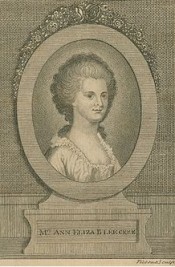
Ann Eliza Schuyler Bleecker, a poet and writer, was living in Tomhanik, north of Albany, when the area came under threat from General John Burgoyne’s army advancing from Canada in 1777. Not only was she afraid of being caught in the midst of the fighting, but she also feared raids by the Indians. Gathering some belongings as Burgoyne approached, Ann Bleecker fled south toward Albany with her two children (her husband was away). Her younger child, Abella, contracted dysentery and died on the way. Griefstricken, Bleecker wrote the following poem in October 1777, though it was not published until 1790, seven years after her death. Ann Bleecker never recovered from the loss during wartime of her sister, her mother, and particularly, her daughter.

WRITTEN IN THE RETREAT FROM BURGOYNE
Rich in my children—on my arms I bore
My living treasures from the scalper’s pow’r:
When I sat down to rest beneath some shade,
On the soft grass how innocent she play’d,
While her sweet sister, from the fragrant wild,
Collects the flow’rs to please my precious child;
Unconscious of her danger, laughing roves,
Nor dreads the painted savage in the groves!
. … But soon my loved Abella hung her head,
From her soft cheek the bright carnation fled;
Her smooth transparent skin too plainly shew’d
How fierce thro’ every vein the fever glow’d.
—In bitter anguish o’er her limbs I hung,
I wept and sigh’d, but sorrow chain’d my tongue;
At length her languid eyes clos’d from the day,
The idol of my soul was torn away;
Her spirit fled and left me ghastly clay!
Then—then my soul rejected all relief,
Comfort I wish’d not, for I lov’d my grief:
‘Hear, my Abella!’ cried I, ‘hear me mourn,
‘For one short moment, oh! my child return;
‘Let my complaint detain thee from the skies,
‘Though troops of angels urge thee on to rise.’
All night I mourn’d—and when the rising day
Gilt her sad chest with his benignest ray,
My friends press round me with officious care,
Bid me suppress my sighs, nor drop a tear;
Of resignation talk’d—passions subdu’d,
Of souls serene and christian fortitude;
Bade me be calm, nor murmur at my loss,
But unrepining bear each heavy cross.
‘Go!’ cried I raging, ‘stoick bosoms go!
‘Whose hearts vibrate not to the sound of woe;
‘Go from the sweet society of men,
‘Seek some unfeeling tyger’s savage den,
‘There, calm—alone—of resignation preach,’
. . . . Nor shall the mollifying hand of time,
Which wipes off common sorrows, cancel mine.

The poem appears on pages 78-79 of In the Words of Women. The illustration is an engraving from the frontispiece of The Posthumous Works of Ann Eliza Bleecker, published in 1793, by Bleecker’s daughter Margaretta V. Fuageres, also a poet.

posted April 18th, 2013 by Janet, Comments Off on Hear, my Abella! cried I, hear me mourn,, CATEGORIES: Children, Death

The world is now turnd up-side down

Unfortunately little is known of Molly Gutridge other than she lived in Marblehead, Massachusetts, and that what she called a “composition” was published as a broadside. She gives us a feeling for what life was like for women during the Revolution: the men are gone, the women struggle with new responsibilities and economic hardships.

A New Touch on the Times Well adapted to the distressing
Situation of every Sea-port Town
By a Daughter of Liberty, living in Marblehead

Our best beloved they are gone,
We cannot tell they’ll e’er return,
For they are gone the ocean wide,
Which for us now they must provide.
For they go on the roaring seas,
For which we can’t get any ease,
For they are gone to work for us,
And that it is to fill our purse.
And to fill our houses too,
What more could we then have them do?
They now do more than we deserve,
Wan’t it for them we now should starve,
Starve then we should and perish too,
And without them what could we do?
We must do as well as we can,
What could women do without man,
They could not do by night and day,
Go round the world, and that they’ll say,
They could not do by day or night,
I think that man’s a woman’s delight,
It’s hard and cruel times, to live,
Takes thirty dollars to buy a sieve.
To buy sieves and other things too,
To go thro’ the world how can we do,
For times they grow worse and worse,
I’m sure it sinks our scanty purse.
Had we a purse to reach the sky,
It would be all just vanity,
If we had that and ten times more,
’Twould be like sand upon the shore.
For money is not worth a pin,
Had we but salt we’ve any thing,
For salt is all the Farmer’s cry,
If we’ve no salt we sure must die.
We can’t get fire nor yet food,
Takes 20 weight of sugar for two foot of wood,
We cannot get bread nor yet meat,
We see the world is nought but cheat.
We cannot now get meat nor bread
By means of which we shake [our head]
All we can get it is but rice
And that is of a wretched price
And as we go up and down,
We see the doings of this town,
Some say they an’t victuals nor drink,
Others say they are ready to sink.
Our lives they all are tired here,
We see all things so cruel dear,
Nothing now-a-days to be got,
To put in kettle or in pot.
These times will learn us to be wise,
We now do eat what we despis’d
I now have something more to say,
We must go up and down the Bay
To get a fish a-days to fry,
We can’t get fat were we to die,
Were we to try all thro’ the town,
The world is now turn’d up-side down.
. . . . . . . . . . . . . . . . . . . . . . . . . . . . . . . .
I now have ended this my song.
——————————

Molly Gutridge’s broadside can be found on pages 44-45 of In the Words of Women.

posted April 15th, 2013 by Janet, Comments Off on The world is now turnd up-side down, CATEGORIES: Daily life, Poetry

next page

   Copyright © 2025 In the Words of Women.