The United States in 1784

“the History of one Day”

The following letter dated 1756 is somewhat earlier than the usual time frame of this blog (1765-1799), but I found it rather charming and worthy of a post. Maria Carter was the daughter of the wealthy Landon Carter of Sabine Hall in Richmond County, Virginia; she is writing about a typical day in her life—she was eleven—to her cousin, also named Maria, of Cleve in King George County. Although it is clear she is being tutored at home and is spending a great deal of time on her work there is no information about what she is studying. In southern families of high status girls received some education: it was far less rigorous and extensive than that of boys and more attuned to the kind of life a woman could be expected to have: as wife, mother, and manager of a household that included slaves.

March 25, 1756My Dear Cousin:
You have rea’y imposed a Task upon me which I can by no means perform viz: that of writing a Merry & Comical Letter: how shou’d [I] my dear that am ever Confined either at School or with my Grandmama know how the World goes on? Now I will give you the History of one Day the Repetition of which without variations carries me through the Three hundred and sixty five Days, which you know compleats the year. Well then first begin, I am awakened out of a sound Sleep with some croaking voice either Patty’s, Milly’s, or some other of our Domestics with Miss Polly Miss Polly get up, tis time to rise, Mr Price is down Stairs, & tho’ I hear them I lie quite snugg till my Grandmama uses her Voice, then up I get, huddle on my cloaths & down to Book, then to Breakfast, then to School again, & may be I have an Hour to my self before Dinner, then the Same Story over again till twilight, & then a small portion of time before I go to rest, and so you must expect nothing from me but that I am Dear Cousin, Most Affectionately Yours Maria Carter.
The letter appeared in “Some Family Letters of the Eighteenth Century” from the Virginia Historical Magazine, pages 432-33. The original is HERE, Series 4.

posted October 31st, 2013 by Janet, comments (1), CATEGORIES: Children, Education

Hester Pitt

William Pitt the Elder (later the Earl of Chatham) led Britain during the Seven Years’ War. His son, William Pitt the Younger, was a member of Parliament during the Revolutionary War. With other Whigs, they opposed to the hard line taken against the American colonies in the 1770s. Pitt the Younger became prime minister at the age of twenty-four and served from 1783 to 1801, and again from 1804 to 1806.

But it is not the political careers of the Pitts that is the subject of this post. Rather it is the contents of a small cache of childhood letters between William Junior and his elder sister Hester, and with their parents, that has been recently digitized by the UK National Archives. William and Hester, two of five children, whom their father, Pitt senior, called his “delightful, promising little tribe,” were educated at home, both by the same tutor. Hester recorded the comment of one Dr. Barnes who thought it unwise to attend school, citing the “danger of taking vice” and complimenting their father for home schooling his children.

Hester began writing letters to her father in Latin at the age of ten! In one she describes a visit to an art museum and signs herself “Sum mi charissime Pater tibi devinctissima, Hester Pitt” (I am devoted to you, my dear father). In another letter Hester says that her brother William—age six!—”does not intend to be a sailor but a William Pitt in the house of Commons.” And that he did.

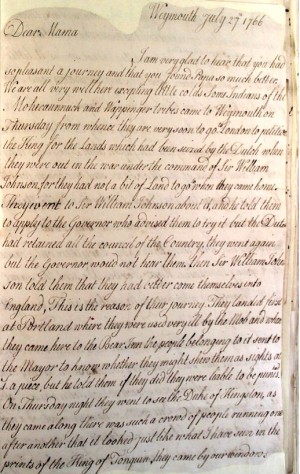
In the summer of 1766 the Pitts spent some time in Weymouth, a fashionable resort. Writing to her mother (Lady Hester Pitt nee Grenville), eleven-year-old Hester reported on the arrival of a group of Native Americans on their way to London to petition King George “for the lands which had been seized by the Dutch when they were out in the war under the command of Sir William Johnson. For they had not a bit of land to go to when they came home.” The Indians had not received satisfaction from local officials and had come to England to appeal to the King directly. Can you imagine how hard it must have been for this group to travel from upstate New York, across the Atlantic and then by land from Portland to Weymouth to London! Hester’s letter is quite legible so you will be able to read, toward the bottom, that the Indians were treated as oddities when they arrived and the proprietors of the inn at which they stayed proposed to charge a fee for people to see them. Like circus freaks.

What a sharp-eyed, thoughtful girl Hester was. She married Charles Stanhope in 1774 and, sadly, died at twenty-five from complications after the birth of their third child.

The portrait of Hester was found HERE.

posted October 28th, 2013 by Janet, comments (1), CATEGORIES: Britain, Children, Education, Indians

“I have a good clean House to live in.”

Although she was living in straitened circumstances, Jane Franklin Mecom, at the age of seventy-four, nevertheless found her simple routine satisfying. She described her day to her brother Benjamin in Philadelphia.

Boston Janr 8–1788
My dear Brother
I have a good clean House to Live in, my Granddaughter constantly to atend me to do whatever I desier in my own way & in my own time, I go to bed Early, lye warm & comfortable, Rise Early to a good Fire, have my Brakfast directly and Eate it with a good Apetite and then Read or work or what Els I Pleas, we live frugaly, Bake all our own Bread, brew small bear, lay in a litle cyder, Pork, Buter, &c. & suply our selves with Plenty of other nesesary Provision Dayly at the Dore. We make no Entertainments, but some Times an Intimate Acquaintance will come in and Pertake with us the Diner we have Provided for our selves & a Dish of Tea in the After Noon, & if a Friend sitts and chats a litle in the Evening we Eate our Hasty Puding (our comon super) after they are gone.

The letter appears on pages 221-22 of In the Words of Women.

posted October 24th, 2013 by Janet, comments (1), CATEGORIES: Boston, Daily life

Jane Mecom gets her due

Jill Lepore, professor of American History at Harvard and a contributor to The New Yorker, has written a biography of Jane Franklin Mecom titled Book of Ages: The Life and Opinions of Jane Franklin. Jane was the sister of Benjamin Franklin, “my peculiar favorite” he called her. The two kept up a correspondence throughout their lives. She kept most of his letters; most of hers to him have been lost. In fact Lepore was quite discouraged because the “paper trail is miserably scant.”

Lepore’s title comes from the record of births and deaths of Mecom’s children, a “litany of grief” Lepore calls it, and rightly so. Jane had twelve children and since all but one died before she did, she had the care of many grandchildren, and even great grandchildren. “Sorrows roll upon me like the waves of the sea,” she wrote. Yet she somehow managed to come to terms with her lot in life. She was not an educated woman, but she had an interest in and opinions on the great questions of the day. Her poor spelling and grammar did not prevent her from expressing herself. She was proud of her brother, and he was supportive of her, sending her money and books, and providing her with housing.

Mecom is one of my favorite women of this period. Posts about her on this blog can be found here, here, here, and here. A review of Lepore’s book appeared in “The New York Times” on September 26, 2013 and can be found here.

posted October 21st, 2013 by Janet, Comments Off on Jane Mecom gets her due, CATEGORIES: Boston, Children, Letter-writing

“This Art . . . will make but little Progress in the World.”

While he was in Philadelphia attending the Continental Congress in 1777, John Adams visited the waxwork exhibit of Rachel Lovell Wells and described what he saw to his wife Abigail in the following letter.

Philadelphia May 10. 1777The Day before Yesterday, I took a Walk, with my Friend [William] Whipple to Mrs. [Rachel] Wells’s, the Sister of the famous Mrs. [Patience] Wright, to see her Waxwork. She has two Chambers filled with it.

In one, the Parable of the Prodigal Son, is represented. The Prodigal is prostrate on his Knees, before his Father, whose Joy, and Grief, and Compassion all appear in his Eyes and Face, struggling with each other. A servant Maid, at the Fathers command, is pulling down from a Closet Shelf, the choicest Robes, to cloath the Prodigal, who is all in Rags. At an outward Door, in a Corner of the Room stands the elder Brother, chagrined at this Festivity, a Servant coaxing him to come in. A large Number of Guests, are placed round the Room. In another Chamber, are the Figures of Chatham,* [Benjamin] Franklin, [John] Sawbridge,** Mrs. Maccaulay,*** and several others. At a Corner is a Miser, sitting at his Table, weighing his Gold, his Bag upon one Side of the Table, and a Thief behind him, endeavouring to pilfer the Bag.

There is Genius, as well as Taste and Art, discovered in this Exhibition: But I must confess, the whole Scaene was disagreable to me. The Imitation of Life was too faint, and I seemed to be walking among a Group of Corps’s [corpses], standing, sitting, and walking, laughing, singing, crying, and weeping. This Art I think will make but little Progress in the World. . . .

* William Pitt, 1st Earl of Chatham, much admired by Americans because of his conciliatory efforts on their behalf
** English Parliamentarian
*** Catharine Macaulay, English historian sympathetic to the Americans in their struggle for independence

The letter can be found HERE.

posted October 17th, 2013 by Janet, Comments Off on “This Art . . . will make but little Progress in the World.”, CATEGORIES: Adams, Abigail, Adams, John, Americans Abroad, Art, Philadelphia

next page

   Copyright © 2026 In the Words of Women.