The United States in 1784

“Some Directions Concerning a Daughter’s Education”

During Nancy Shippen Livingston’s stay in Philadelphia in 1783, she gave some thought to the sort of education she would like her child to have. Here is what she listed in her Journal Book. Ambitious, wouldn’t you say. By the word “use” in items 14, 28 and 35, she meant “get her used to.”

1st. Study well her constitution & genious
2d. Follow nature & proceed patiently.
3d. Suffer not Servants to terrify her with stories of Ghosts & Goblins.
4th. Give her a fine pleasing idea of Good, & an ugly frightful one of Evil.
5th. Keep her to a good & natural regimen of diet.
6th. Observe strictly the little seeds of reason in her, & cultivate the first appearance of it diligently.
7th. Watch over her childish Passions & prejudices, & labour sweetly to cure her of them.
8th. Never use any little dissembling arts, either to pacify her or to persuade her to anything.
9th. Win her to be in love with openness, in all her acts, & words.
10th. Fail not to instill into her an abhorance of all “serpentine” wit.
11th. If she be a brisk witty child do not applaud her too much.
12th. If she be a dul heavy child, do not discourage her at all.
13th. Seem not to admire her wit, but rather study to rectify her judgment.
14th. Use her to put little questions, & give her ready & short answers.
15th. Insinuate into her the principles of politeness & true modesty, & christian humility.
16th. Inculcate upon her that most honorable duty & virtue SINCERITY.
17th. Be sure to possess her with the baseness of telling a Lye on any account.
18th. Shew her the deformity of Rage & anger.
19th. Never let her converse with servants.
20th. Acquaint her in the most pleasant & insinuating manner, with the sacred History, nor let it seem her lesson, but her recreation.
21st. Set before her the gospel in its simplicity & purity, & the great Examples of Antiquity unsophisticated.
22d. Explain to her the nature of the baptismal san[c]tion
23d. Prepare her in the best manner for confirmation.
24th. Animate, & instruct her for the holy communion.
25th. Particularly inform her in the duties of a single & married state.
26th. Let her be prepared for the duties & employment of a city life, if her lot should be among citizens.
27th. See she be informed in all that belongs to a country life.
28th. Discreetly check her desires after things pleasant, & use* her to frequent disappointments. *Ro[u]sseau
29th. Let her be instructed to do every thing seasonably & in order, & what ever she is set to do let her study to do it well, & peaceably;
30th. Teach her to improve everything that nothing may be lost or wasted, nor let her hurry herself about any thing.
31st. Let her always be employed about what is profitable or necessary.
32d. Let nothing of what is committed to her care be spoil’d by her neglect.
33d. Let her eat deliberately, chew well, & drink in moderate proportions.
34th. Let her use exercise in the morning.
35th. Use her to rise betimes in the morning, & set before her in the most winning manner an order for the whole day.

When wisdom enters into her heart, & knowledge is made pleasant to her soul, “discretion shall preserve her, & understanding shall keep her.”

This entry can be found on pages 148-49 of Nancy Shippen’s Journal Book. The portrait of Nancy Shippen Livingston can be found here.

posted June 27th, 2013 by Janet, Comments Off on “Some Directions Concerning a Daughter’s Education”, CATEGORIES: Children, Education

“cruel, cruel fate”

Nancy Shippen’s mother was sympathetic to Louis Guillaume Otto’s suit. Her father less so, as can be discerned from the letter in the previous post. His view prevailed. The financial security and social status that Henry Beekman Livingston represented were foremost in his mind, and he was able to convince Nancy that he was right. Hurried preparations were made for the marriage (March 14, 1781). Otto was distraught. He wrote to Nancy: “I am yours for ever; though perhaps you will never be mine.”

Nancy was barely eighteen, a gay young thing, when she married Henry Beekman Livingston and moved to his house in Rhinebeck on the Hudson, where she was surrounded only by the closely knit Livingston family—a far cry from the bustling Philadelphia she was used to. Nancy soon learned that her husband, next to the youngest of four sons and six daughters of Margaret Beekman and Robert R. Livingston III, was arrogant, temperamental, subject to fits of rage when thwarted, and insanely jealous. He was used to having his way with women, too, having sired several illegitimate children, some with slaves.

Finding herself pregnant soon after their marriage, Nancy lobbied hard and long to go to back the Shippen house in Philadelphia to give birth. She succeeded, and on December 26, 1781, she was delivered of a girl named after her mother-in-law Margaret. Nancy adored little “Peggy.” Obliged to return to Rhinebeck she attempted to mend her marriage, but by the spring of 1783, she had had enough. Packing some personal belongings she fled with her child once again to her parents’ house in Philadelphia. It was at this point that she began her Journal Book. On May 10, at ten o’clock at night, she wrote:

Miserable all day— in consequence of a letter from Lord B [her husband]. He tells me—O what is it that bad he does not tell me! but what affect[s] me most is his accusing me of infedelity. Wretched Unhappy man—Nothing but your being jealous, & treating me ill in consequence of that jealousy, shou’d have tempted me to leave you & now you say I left you because I loved another. Had you not decieved me by so often swearing you loved me to distraction I should not have been the wretch I am. O I’m wretched indeed! & the father too of my sweet baby—I’m almost distracted—

Her entry on May 16 reads:

Papa told me this morng at breakfast that I must send my darling Child to its Grandmama Livingston. … I told him I cou’d not bear the Idea of it, that I had sooner part with my life almost than my Child. He told me it was for the future interest of my baby, that its fortune depended on the old Lady’s pleasure in that particular— beg’d me to think of it, & to be reconciled to it. If I know my own heart I never can. When will my misfortunes end! I placed my happiness in her! She is my all & I must part with her! cruel cruel fate—

She wrote on May 22:

I spend so much of my time in caressing & playing with Peggy that I allmost forget I have any thing else to do—I forget to read—to write—to work—in short I neglect the business of the day. At night I sit down to unfold my thoughts on paper—I love it much—me thinks it is allmost as pleasing as telling them to a friend. My child sleeps— I am sitting close by her—I feel happy at present because I put off the future prospect from my thoughts— I hope for the best—& enjoy the present moment.

to be continued …

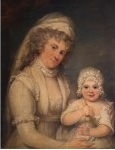
Quoted passages are from Nancy Shippen’s Journal Book, pages 143, 145, 147. The painting of Nancy Shippen Livingston and daughter Peggy can be found here.

posted June 24th, 2013 by Janet, Comments Off on “cruel, cruel fate”, CATEGORIES: Children, Marriage, New York, Philadelphia

” … Nancy is much puzzled between Otto & Livingston.”

In 1778, two events changed the character of the Revolution. The British left Philadelphia for the Tory stronghold of New York which became the center of British power in America and was occupied until the end of the war. Also during that year France signed a Treaty of Alliance with the United States, bolstering its war effort with supplies, troops and naval vessels. Congress returned to Philadelphia, now in the hands of American forces under the command of General Benedict Arnold, and with elaborate ceremony welcomed the French minister to the United States.

Although her husband was still in the field and her son at school, Alice Shippen was once more back in her own home with her daughter Nancy, now fifteen, educated, “finished,” and more than ready to take her place in society. And to be courted. One of her suitors was Colonel Henry B. Livingston, a member of the wealthy New York Livingstons, who had served with valor during the war. Another was the secretary of the French Minister to the United States, Louis Guillaume Otto (on the left). Nancy Shippen. He soon became enamored of her to the point of composing music for her, exchanging poems with her, passing by her house on a regular basis, eventually visiting her frequently and playing the harpsichord with her. Nancy’s father, Dr. William Shippen, wrote this letter to his son Thomas who was back at school in Maryland after the new year festivities. He summarizes the situation nicely.

… Nancy is much puzzled between Otto & Livingston. She loves ye first & only esteems the last. On Monday she likes L & his fortune. On Tuesday even when O comes he is the angel. L will consummate immediately. O not these 2 years. L has solicited the Father & Mother. O is afraid of a denial. In short, we are all much puzzled. L has 12 or 15,000 hard. O has nothing now, but honorable expectations hereafter. A Bird in hand is worth 2 in a bush. They are both sensible. O handsome. What do you think of it?

Dr. Shippen’s letter appears in Nancy Shippen Her Journal Book, compiled and edited by Ethel Armes, page 101. The image of Otto, watercolor on ivory, ca. 1780, was painted by Charles Wilson Peale and is at the Smithsonian American Art Institute.

posted June 20th, 2013 by Janet, Comments Off on ” … Nancy is much puzzled between Otto & Livingston.”, CATEGORIES: Capital of the United States, Courtship, France, Philadelphia

“I may … reward you … if you are a very good Girl”

Following is the next letter Alice Lee Shippen wrote to her daughter at Mrs. Rogers’ school. It deals solely with what in a time of war would seem to be petty matters. But so it was with many privileged young people. Note also that parents often promised rewards for desirable behaviors on the part of their children. Bribes you might call them.

My dear Nancy
Why don’t you write to me & tell me how you do & how you improve in your work, in writing & drawing, in your address, in holding yourself & in the Graces. These are absolutely necessary to make you shine, but above all let me know how you improve in humility, patience & love, these will make my dear Girl shine to all eternity. These are the inheritance that fadeth not away. I was pleased with your last & only letter I received since I left you. I say it pleased me because it informed me your good Mrs Rogers has found out a way of encourageing you in your work & pays great attention to your improvement & by way of joining her in encourageing you to be industrious, which makes so great a part of a female character. I have sent to Carolina for Tambour cotton, silk & needles, & that I may be prepared to reward you if Mrs Rogers should write me you are much improved & are a very good Girl. I have sent for some very pretty things which I can either bestow upon you or dispose of in another way if you should not answer my expectations. I have sent you silk for a bonnet & cloak which you must take great care of, not only because a young Lady should not dirty free online australian pokies her cloathes but because they cost your Papa so much money. I wou’d have had them made here but that they wou’d have been spoild in coming to you. No trimmings of any sort can be got therefore you must make your squirell skin do. I have sent flanel to line it which is genteel & very warm & that I know you like. I wou’d have sent you black silk for a bib & apron but can’t get any in this place, but I have desired your Papa to look out. … yr Collar is at Bethlehem, your Papa I hope will remember to bring it you for I am sure it is absolutely necessary for you. I send you a yard of cambrick which you may give as much as you please of to your Polly for caps. The book muslin I send is to work a pr of ruffles for General Washington. I should like them grownded like the Apron Mrs Rogers shewed me & I am sure if you do them well they will be taken for lace, but it is impossible for me to get thread. You need not make Bobins for me I shall not want them. Has your Uncle Joe given you the dimity? he promised me he wou’d. I have some thoughts of going to Virginia when I return with your dear Brother. If I should I will bring Mrs Rogers a pupil, one of your pretty Cousins. Present my Compliments to Mrs Rogers & that you may so improve as to do her credit & make Your Papa & me happy is the Prayer of
Your very Affe Mother
A. Shippen

This letter appears in Nancy Shippen: Her Journal Book, online, pages 40-41.

posted June 17th, 2013 by Janet, Comments Off on “I may … reward you … if you are a very good Girl”, CATEGORIES: Children, Clothes, Education

“my fears render me so miserable”

Having fled Philadelphia when the British occupied the city Alice Lee Shippen took refuge at the Lee family home in Virginia. She felt out of touch there and was frantic with worry about her husband and Tommy their son. She wrote:

Stratford 17 Janry. 1778My dear Mr. Shippen,
What is become of you & my dear Tommy—it is almost 3 months since I left my dear Mr. Shippen & I have received but one short letter with my gown & apron but you are harried with business, your good for nothing Doctors & commisarys give you all the Trouble. O! when shall I have you all to myself? & it is now two months since I parted with our dear our only son, the pledge of our love & have not heard once from him—surely if he was well he wou’d contrive a letter to me, he is certainly ill or dead of that vile feaver Crags son had, my fears render me so miserable it is impossible for me to stay here where I find I cannot hear from those I love most. I shall return to Frederick-Town where you must my dear Mr. Shippen get a lodging for me. . . . If I cou’d correspond with you . . . at this distance it would be some thing, but when I set down to write I feel myself tied up [with] the uncertainty of what I write getting to you only, I cou’d now fill a volume but no matter you shall know all when we meet. Perhaps it will be in the world of spirits & then we can convey our Ideas with delightful ease & certainty.
Are you sorry for the Ladies of Philadelphia? Had they taken my advice they wou’d now have breathed in free air as I do. O! how good it is to do right, My dear Mr Shippen tho’ we are loosing thousands having loved [our] country and its interests invariably more than supports me under every difficulty. I feel I love in my very heart the true liberty of America the liberty of saying & doing everey thing that is beautiful & proper.
Adieu my dear faithful husband, direct for me at the Post Office at Leedstown & believe for it is really true that I am intirely & unalterably Yours

Alice Shippen’s letter appears on page 119 of In the Words of Women. The illustration is of Stratford Hall; information about the Lee plantation can be found here.

posted June 13th, 2013 by Janet, Comments Off on “my fears render me so miserable”, CATEGORIES: Children, Patriots, Philadelphia

next page

   Copyright © 2026 In the Words of Women.