The United States in 1784

take this petition into consideration

Women were recruited by officers and surgeons during the American Revolution to nurse the wounded. While the service of many nurses was acknowledged, some were not paid their due.

Alice Redman, a nurse during the War, whose pay was meager at best, but whose generosity and sense of duty were enormous, petitioned the Governor and Council of the State of Maryland around 1780 for expenses she had incurred during her service.

To the honourable the Governor and council, the Humble Petition of Alice Redman one of the nurses at the hospital [like the one shown in Yellow Springs outside Philadelphia in 1755] and your petitioner in duty Bound will Ever Pray. Alice Redman

P.S. She your petitioner out of that two dollars pr. month is oblige to buy brooms and the soap we wash with if your honors will please to relieve your petitioner your petitioner will ever be bound to pray

Records indicate that Redman was reimbursed March 28, 1781.

George Washington issued instructions for nurses. They were to

• administer the medicine and diet prescribed for the sick according to order;
• be attentive to the cleanliness of the wards and patients, but to keep themselves clean, they are never to be disguised with liquor;
• see that the close-stool or pots are to be emptied as soon as possible after they are used …
• see that every patient, upon his admission in to the Hospital is immediately washed with warm water, and that his face and hands are washed and head combed every morning …
• [sweep] their wards … every morning or oftener if necessary and … [sprinkle them] with vinegar three or four times a day …
• [never] to be absent without leave.

Redman’s petition can be found on pages 167-8 of In the Words of Women. Washington’s description of the duties of nurses is on page 167. The illustration of the hospital was done by English traveler William Strickland in 1755.

posted October 29th, 2012 by Janet, Comments Off on take this petition into consideration, CATEGORIES: American soldiers, Health, Medicine, Washington, George

The Presidents House

Washington became the capital of the United States in the summer of 1800. In November of that year President John Adams and his wife Abigail took up residence in that city and the house built for the president. Abigail described her new surroundings in a letter to her daughter Nabby.

Washington, 21 November, 1800city, which is only so in name. Here and there is a small cot[tage], without a glass window, interspersed amongst the forests, through which you travel miles without seeing any human being. In the city there are buildings enough, if they were compact and finished, to accommodate Congress and those attached to it; but as they are, and scattered as they are, I see no great comfort for them.

The [President’s] house is upon a grand and superb scale, requiring about thirty servants to attend and keep the apartments in proper order, and perform the ordinary business of the house and stables; an establishment very ill proportioned to the President’s salary. The lighting the apartments, from the kitchen to parlours and chambers is a tax indeed; and the fires we are obliged to keep to secure us from daily agues is another very cheering comfort. … if they will … let me have wood enough to keep fires, I design to be pleased. I could content myself almost anywhere three months; but surrounded with forests, can you believe that wood is not to be had because people cannot be found to cut and cart it? … We have, indeed, come into a new country.

You must keep all this to yourself, and, when asked how I like it, say that I write you the situation is beautiful, which is true. The house is made habitable, but there is not a single apartment finished. … We have not the least fence, yard, or other convenience, without, and the great unfinished audience-room I made a drying-room of, to hang up the clothes in. The principal stairs are not up, and will not be this winter. Six chambers are made comfortable; two are occupied by the President and Mr. Shaw*; two lower rooms, one for a common parlour, and one for a levee-room. Upstairs there is the oval room, which is designed for the drawingroom, and has the crimson furniture in it. It is a very handsome room now; but, when completed, it will be beautiful. If the twelve years, in which this place has been considered as the future seat of government, had been improved, as they would have been if in New England, very many of the present inconveniences would have been removed. It is a beautiful spot, capable of every improvement, and the more I view it, the more I am delighted with it. …
Affectionately, your mother
* William Smith Shaw, the son of Abigail Adams’s sister Elizabeth, was the president’s private secretary.

In early November John, already in Washington, sent a note to Abigail expressing the hope that “none but honest and wise men [shall] ever rule under this roof.”

The letter appears in The White House: A History of the Presidents by Kenneth W. Leish, pages 138-139. The painting is by William Birch ca. 1800.

posted October 25th, 2012 by Janet, Comments Off on The Presidents House, CATEGORIES: Adams, Abigail, Adams, John, Capital of the United States

Master Bacon maintained a stern decorum

After the Revolution, more attention was paid to the education of girls than theretofore in the expectation that they, as “republican mothers,” would be better able to raise good citizens of the new United States. Sarah Anne Emery of Massachusetts (see previous post) was sent to school at an early age. Ninety years later she vividly recalled her experience. Note that the curriculum continued to emphasize feminine skills.

The summer I was four years old [1793-4] I began to attend school. … My first teacher, Master Zach. Bacon, was a native of Bradford. Female teachers would then have been deemed inadmissible in a district school. It would not have been thought possible that order could be maintained under feminine rule, where often more than half the scholars were unruly boys, many of the eldest men grown. … The school room was furnished with a desk and a flag-seated chair for the teacher; a clumsy square board table stood in the centre … surrounded by high, wooden benches. Here were seated the older pupils; the younger ones were placed on low forms ranged around the walls. The scholars were divided into four ranks: the “Bible,” “Testament,” “Spelling Book,” and “Primer” class. … The older scholars studied arithmetic, and wrote. … Master Bacon … maintained a stern decorum, quite awful to a timid novice like myself; but as I had already mastered by alphabet and was exceedingly fascinated by my new primer, I immediately became a favorite with the teacher.

The summer I was eight years old, a Miss Ruth Emerson, from Hampstead, N.H., collected a select school. There were from twenty to thirty scholars, mostly girls; there were a few small boys. I believe the tuition was but six cents a week. This lady promoted us into “Webster’s Spelling Book” and “Webster’s Third Part”—books then just coming into use. Miss Emerson was a most accomplished needlewoman, inducting her pupils into the mysteries of ornamental marking and embroidery. This fancy work opened a new world of delight. I became perfectly entranced over a sampler that was much admired, and a muslin handkerchief, that I wrought for mother, became the wonder of the neighborhood.


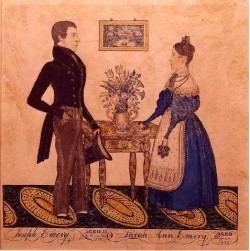
When she was 20, Sarah Anne married Joseph Emery.

Excerpts are from In the Words of Women, page 231 and Reminiscences of a Nonegenerian by Sarah Ann Emery (Newburyport, Mass., William H. Huse and Co., 1879). Read more about Emery HERE. The Illustration of the couple is dated 1834 and is attributed to Joseph H. Davis. It is at the Fenimore Art Museum in Cooperstown, NY.

posted October 22nd, 2012 by Janet, Comments Off on Master Bacon maintained a stern decorum, CATEGORIES: Education

“Mrs. Salters recipe for a burn”

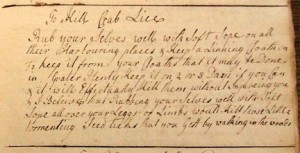
In eighteenth century America women were usually the first responders when it came to illness in their families. The well-to-do might consult physicians, and a good many patronized apothecaries who functioned as pharmacists. Many women kept receipt [recipe] books detailing remedies for many illnesses and conditions. Elizabeth Coates Pascall’s treatment for crab lice is pictured.

Sarah Anne Emery recalled how her brother was successfully treated by a remedy suggested by a neighbor.

My little brother, like other baby boys, toddling into mischief, contrived, during the momentary absence of mother, to pull over the teakettle, which was standing in the chimney corner, scalding his right arm and hand badly. … Poor little Jim’s arm grew worse, Mother and Aunt Sarah became anxious, when one of the neighbors brought in Mrs. Salter’s recipe for a burn. … It was concluded to try the prescription. A linen glove and sleeve were fitted over the burn, these were kept saturated with a mixture of olive oil and snow water, beat to a froth. In less than a week the sore was healed and a new skin formed.

Emery’s description is on page 163 of In the Words of Women. Other receipts recorded by Elizabeth Coates Paschall can be found HERE.

posted October 18th, 2012 by Janet, comments (2), CATEGORIES: Health, Medicine

A Watch for a Chatelaine

In 1797, Mary Stead Pinckney, the wife of Charles Cotesworth Pinckney who had recently been appointed minister to France, while waiting for his credentials to be accepted by the French government, took the opportunity to visit Parisian porcelain factories. French porcelain had become fashionable in America since the alliance with France during the American Revolution.

Mrs. [Henry] Middleton, Ralph [Stead Izard], Eliza [Izard], myself, and a gentleman to conduct us went yesterday to visit the Angouléme manufactory of china … cups & saucers with beautiful miniature figures rivaling the first masters on ivory. Vases from 50 to 1000 louis a pair—an absolute picture … we went to see the whole process, from the lump of clay which they were rolling about as if for a tart, till it took the form of the beautiful ware we had so much admired before. … If I remain in France I shall certainly visit the manufactory of Séve [sic], which is generally accounted superior to that of Angouléme.

While in Paris Mrs. Pinckney commissioned a watch for her thirteen-year-old-niece Eliza Izard. It was the fashion at the time for upper class women to wear chains around their waists to which were attached watches, sewing implements, penknives, and other such items. These chains, or chatelaines, were referred to as “macaronis” after those worn by London dandies who were members of the Macaroni Club.

The letter to Rebecca Izard in January 1797 appears in the Letterbook of Mary Stead Pinckney, Charles F. McCoemb, ed., (New York: Grolier Club, 1946). Eliza Izard’s portrait (1801) is by Edward Greene Malbone, courtesy of Gibbes Nueun of Art: Carolina Art Association. The watch and photograph are from the Charleston Museum in South Carolina.

posted October 15th, 2012 by Janet, Comments Off on A Watch for a Chatelaine, CATEGORIES: Americans Abroad, France, Paris

next page

   Copyright © 2025 In the Words of Women.