The United States in 1784

“… a frightful diversion …”

In the previous post Janet Schaw described her voyage from Scotland to America to visit her brother’s plantation in North Carolina. On her arrival she continued to chronicle her experiences in exquisite detail, giving this account of what she called “a frightful diversion” near his property.

On a visit down the river, an Alligator was observed asleep on the bank. Mrs. Schaw [her sister-in-law] was the first who saw it, and as she is a notable house-wife was fired with revenge at the loss of many a good goose they had stolen from her. We crept up as softly as possible hardly allowing the oars to touch the water, and were so successful as to land part of the Negroes before it waked, which it did not do till all was ready for the attack. Two of the Negroes armed with strong oars stood ready, while a third hit him a violent blow on the eye, with which he awaked and extended such a pair of jaws as might have admitted if not a Highland cow, as least a Lowland calf. The negroes who are very dextrous at this work, presently pushed the oars down his throat, by which means he was secured, [but not] till he received thousands of blows which did him no harm, as he is covered with a coat of Mail, so strong and compact, that he is vulnerable no where but in the eye, and a very small opening under the throat and belly. His tail is long and flexible, and so are his huge arms. With these he endeavoured to catch at his assassins, but the superior arts of man are more than a match for his amazing strength. Was superior reason never used to a more unworthy purpose it were well; for he is a daring Villain, an insolent robber, who makes war on the whole animal creation, but does not man do the same? Even worse, for this monster does not devour his fellow-monsters. …

The above passage is from In the Words of Women, Chapter 5, page 136.

posted March 29th, 2012 by Janet, Comments Off on “… a frightful diversion …”, CATEGORIES: Daily life, Slaves/slavery

“… a sudden and violent heel over …”

I am all admiration for Janet Schaw, a Scotswoman who sailed to North Carolina in 1774. Her journal conjures otherwise unimaginable realities of a voyage of seven weeks to the West Indies and an additional twenty-four days to Charlestown. Here is her account of the impact below decks when the ship “broached to,” or rolled onto one side. It is a catalog of horrors—with a sudden, comic conclusion.

We were sitting by our melancholy Taper, in no very chearful mood ourselves; my brother … was within the companion ladder. The Captain had come down to the Cabin to overhaul his Log-book and Journal, which he had scarcely begun to do, when the Ship gave such a sudden and violent heel over, as broke every thing from their moorings, and in a moment the great Sea-chests, the boys’ bed, my brother’s cott, Miss Rutherfurd’s Harpsicord, with tables, chairs, joint-stools, pewter plates etc, etc., together with Fanny, Jack and myself, were tumbling heels over head to the side the Vessel had laid down on.

It is impossible to describe the horror of our situation. The candle was instantly extinguished, and all this going on in the dark, without the least idea of what produced it, or what was to be its end. The Capt sprung on deck the moment he felt the first motion, for he knew well enough its consequence; to complete the horror of the scene, the sea poured in on us, over my brother’s head, who held fast the ladder tho’ almost drowned, while we were floated by a perfect deluge … a favourite cat of Billie’s … happening to be busily engaged with a cheese, just behind me, she stuck fast by it, and sadly frighted with what she as little understood as we did, mewed in so wild a manner, that if we had thought at all, we would certainly have thought it was Davy Jones the terror of all sailors, come to fetch us away.

Busy as this scene appears in description, it did not last half the time it takes in telling. Nothing can save a ship in this situation, but cutting away her masts, and the time necessary for this generally proves fatal to her, but our masts were so shattered by the late storm, that they went over by the Board of themselves, and the Vessel instantly recovered. This second motion, however, was as severely felt in the Cabin as the first, and as unaccountable, for we were shoved with equal Violence to the other side, and were overwhelmed by a second deluge of Sea water. At last however it in some degree settled, and, thank God, no further mischief has happened, than my forehead cut, Jack’s leg a little bruised, and the last of our poultry, a poor duck, squeezed as flat as a pancake.

When the light was rekindled, a most ridiculous scene was exhibited, vizt the sight of the Cabin with us in it, amidst a most uncommon set of articles. For besides the furniture formerly mentioned, the two state rooms had sent forth their contents, and the one occupied by the Captain, being a sort of store room, amongst many other things a barrel of Molasses pitched directly on me, as did also a box of small candles, so I appeared as if tarred and feathered, stuck all over with farthing candles.

This excerpt is from In the Words of Women Chapter 9, pages 249–250.

posted March 26th, 2012 by Janet, comments (1), CATEGORIES: Ocean Voyages

“the most fashionable head Dress …”

Harriet Wadsworth, the sixteen-year-old daughter of Jeremiah Wadsworth and Mehitable Russell of Hartford, Connecticut, writing from New York City, gave her mother a careful description of the latest fashions in headwear. One feature paid homage to the successful flights of a new invention, the Montgolfier hot-air balloon.

March 17, 1785I will now write a little about the Fashions which are very numerous. The young Ladies of my age wear larg Queens Caps, in the morning at home. If they go out to pay morning visits they ware Some kind of Silk gown larg white Sattin Bonnets and long Cardnals*—mine is white Sattin trimmed with white furr—at home when they receive Company they Ither ware half-Dress Caps—or pin Gaus [gauze] on their heads but most Commonly the former. Hoops at all times, but Small ones in the morning—at the
Assembleys they ware full Dress Corsser [corsage] flowers, Gaus and feathers As their fancy directs. When they pay afternoon visits, the most fashionable head Dress is a Balloon hat or Levena Bonnet—Some wear half Dress Caps, the Levene Bonnet I think very becoming.

* a hooded cloak, originally red

A caricature showing balloon-style clothing ca. 1785.

This excerpt is from In the Words of Women, Chapter 8, page 223.

posted March 22nd, 2012 by Janet, Comments Off on “the most fashionable head Dress …”, CATEGORIES: Fashion, New York

Research—exciting … and sometimes surprising!

Fatti maschi, parole femine, a seventeenth-century Italian saying translated as “masculine deeds, feminine words” may be considered the motto that binds our book together. To find these “feminine words,” we delved into the archives of many historical societies, libraries, and museum collections, often traveling many miles to do so.

The expansion and usefulness of the Internet as a research tool cannot be underestimated, for it helped us locate materials we might not have found without it. The Internet does have to be used with caution, however, so we checked and double-checked all of our materials. Whenever possible, we tried to track down the original documents for comparison with any published texts. Microfilms and digitized images of documents were invaluable when we could not get to far-away depositories.

But what a thrill it is to hold in one’s hand an eighteenth-century letter, let’s say by Sarah Livingston Jay at the Columbia University’s Rare Book & Manuscript Library—to delight in her neat handwriting, to see the trace of the sealing wax, to read her husband’s annotation at the edge as to when he received the letter. The real thing has an immediacy that is lost when viewed as a digitized page or as a transcription in printed form.

We did, of course, have to resort to secondary sources, especially when dealing with copyrighted materials. For example, we wished to use a letter of 31 January 1776 written by Martha Washington to her sister. It had been published in Joseph E. Field’s Worthy Partner: The Papers of Martha Washington [1994], which stated that the letter was in the Washington Headquarters Library, Morristown, New Jersey. Upon inquiring whether we might come to have a look at the original, we were told the site did not have the letter. Conferring with history experts and other libraries, we found a nineteenth-century publication containing the letter (out of copyright) and used it in our book instead.

Cambridge January the 31, 1776My dear Sister
I have wrote to you several times, in hopes it would put you in mind of me, but I find it has not had its intended affect. I am really very uneasy at not hearing from you and have made all the excuses for you that I can think of but it will not doe much longer. If I doe not get a letter by this nights post I shall think myself quite forgot by all my Freinds. The distance is long yet the post comes in regularly every week. …

* Note the (what we think of as) misspellings; “Freinds” meant family in 1776, but Martha’s feelings of anxiety in not receiving news from home is very contemporary.

Imagine our surprise—and delight—when some weeks ago, we received an e-mail from the Washington Headquarters Library stating that, while looking for something else, the staff, opening an unmarked box, had found the sought-after letter, and in good condition too!

That’s what makes research exciting: those unexpected surprises!
Posted by Louise V. North.

The excerpt is from In the Words of Women, page 41.

posted March 19th, 2012 by Janet, Comments Off on Research—exciting … and sometimes surprising!, CATEGORIES: Research

“We the Ladys of Edenton … “

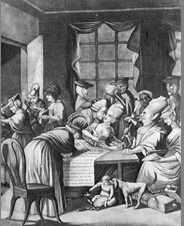
Fifty-one ladies of Edenton, North Carolina, met together in 1774 and resolved to abstain from drinking tea as well as from purchasing English goods, thereby supporting the resistance to the taxes throughout the colonies. Their action was noted in England, and a print by Philip Dawe published in London portrayed this patriotic deed in less than complimentary terms, caricaturing the ladies as inebriated or flirtatious, and neglectful of the child under the table. Most humiliating, a dog urinates on the gown of one of the signers.

Resolution of October 25, 1774
We the Ladys of Edenton do hereby Solemnly Engage
not to Conform to ye Pernicious Custom of Drinking Tea,
or that we the aforesaid Ladys will not promote ye wear
of any Manufacture from England untill such time
that all Acts which tend to Enslave this our Native Country
shall be Repealed.

This excerpt is from In the Words of Women, Chapter 1, page 24. Illustration: Philip Dawe(?), A Society of Patriotic Ladies, at Edenton in North Carolina, mezzotint, Prints and Photographs Division, Library of Congress.

posted March 15th, 2012 by Janet, comments (1), CATEGORIES: Patriots, Resistance to British

next page

   Copyright © 2026 In the Words of Women.