The United States in 1784

“the city does not answer my expectation”

In 1769, Joseph Reed prepared to leave America and go to England where he hoped to marry Esther De Berdt and find some employment. In December, however, his father took ill and died. He delayed his journey to settle his parent’s affairs and in March sailed for London via Ireland intending to make a new life there. On arriving in Ireland, however, he learned from the English newspapers that Esther’s father had died. When he reached London he found that Mr. De Berdt’s mercantile business had gone bankrupt and that the family was not only in mourning but also in financial distress. It became clear that the best course would be for the lovers to marry, which they did in May of 1770, and go to America taking Esther’s mother with them.
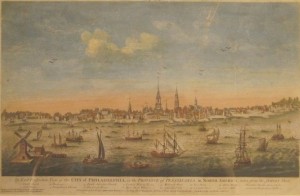
Esther’s letter to her brother Dennis tells of her arrival in Philadelphia, where the newlyweds had decided to live, and her reaction to her new surroundings.

Philadelphia, Nov. 14th, 1770. . . . Everything on the passage was on the whole as agreeable as possible, but I was worn almost to a skeleton by the constant sickness, but America has set me up again; yet, though I was so glad to see land, the first week or two, I was very low-spirited;—indeed it is not England:—however, I can think of spending some time agreeably enough. Nothing can be more obliging than our friends; they seem to strive which can show most hospitality and respect. I am sure, after the first weeks, you would like this place very well:—the city does not answer my expectation;—the plan, undoubtedly, is remarkably good;—but the houses are low, and in general, paltry, in comparison of the account I had heard. . . . We made our appearance on Thursday at the assembly. . . . the belles of the city were there. In general, the ladies are pretty, but no beauties; they all stoop, like country girls. So much for this city. . . .

Esther spent some time in Burlington, New Jersey, where she was “much diverted with what they called ‘a hunt.'”

The people, the horses, and dogs, were well matched. The first at setting out was a black man, on a horse whose coat stood about two inches from his body;—three gentlemen attended—one was the apothecary, another the Mayor, and the third [illegible], all on horses about as high as my old Fanny, and with the same porcupine appearance as the first;—however, about noon they returned, with a fine fox, and well satisfied.

William B. Reed, Esther De Berdt, afterwards Esther Reed, of Pennsylvania (Philadelphia: C. Sherman Printer, 1853), 157-59. The illustration is by Carington Bowles after George Heap. “An East Perspective View of the City of Philadelphia, in the Province of Pensylvania, in North America, taken from the Jersey Shore.” London: Bowles, [1778]-ca. 1790. 9 1/2 x 16 1/4. Engraving. Original gouache hand coloring.

posted September 28th, 2015 by Janet, comments (0), CATEGORIES: Philadelphia, Reed, Esther De Berdt, Reed, Joseph

“you have nothing to fear from any rivals”

The correspondence between Esther De Berdt in England and Joseph Reed in America continued. Esther remained constant in her love as did Joseph, although circumstances kept them apart, not least the deteriorating relations between the colonies and the mother country and the failure of plans to secure a position for Reed in England. She wrote Reed from Enfield 22 October 1767.

I [am] happy to find that you were relieved from the anxiety and fears arising from my seemingly long silence. These are pains we must be subject to, while absent from each other. However, I hope that one day all [will] be forgot in the pleasure of meeting; and, though long delayed, nothing shall tempt me to give up the pleasing expectation. Three years are now past, since I was made happy by your company here, and though I am surrounded by my friends, yet I own to you, there is a heaviness about my heart that I cannot get rid of, when I recollect how much happier I have spent this day of the year [her birthday]; and now I receive no small pleasure in thinking that perhaps while I am writing, your thoughts are with me, and paying a visit, though but in imagination. However, any way, I . . . please myself with the fond hope that before another year passes, I shall have it in my power to realize the happiness of bidding you welcome, and in a greater degree add to your comfort and ease than I ever had it in my power to do, and this shall be the delightful employment of my future life. . . . Indeed, it has long been my study to improve and cultivate those qualities your partiality imagines I possess. But in whatever you are disappointed, this you will ever find true, that my heart is fixed in its choice of the object of its affection and esteem, and never had a latent wish to change.
I really believe it is unnecessary for me to say you have nothing to fear from any rivals, who, though in some circumstances suitable, are very far from having the least share of my love, nor is there any foundation for you being apprehensive that I shall ever give encouragement to hopes which I never intend to gratify. . . . I find our connexion is no longer a secret among our friends in America. . . . I am at a loss to know how they came by their intelligence. . . . Oh! my dear friend, how long will it be before I can let them know whom I have distinguished as the companion of my future life, and give you the last and dearest proof of the sincerity and constancy of my affection? But this is hid in the dark womb of futurity, and it is for us to wait in patience. This liberty of communicating our thoughts is yet left us. . . .
I am persuaded you do not forget me . . . for I should not be happy if I did not think your judgment and reason were in my favor. . . .
Adieu, my very dear friend, and never doubt the sincerity or affection of
Yours,
E. De Berdt

William B. Reed, Esther De Berdt, afterwards Esther Reed, of Pennsylvania (Philadelphia: C. Sherman Printer, 1853), 123-26.

posted September 24th, 2015 by Janet, comments (0), CATEGORIES: Britain, Courtship, Reed, Esther De Berdt, Reed, Joseph

“I was quite amazed at the confusion and disorder . . . “

Anyone who has visited the House of Commons or watched Question Time with the Prime Minister on television will know that MPs can be very noisy in their responses to statements by the speakers: if in approval with shouts of “Hear, hear!” and at other times with raucous sounds of disapproval, prompting the Speaker to shout “Order, order!” I must say I find this sort of behavior in a legislative body unsettling and quite distasteful. Esther De Berdt was sufficiently interested in politics to attend a session of the Commons and remarked on this behavior in a letter she wrote to her betrothed, Joseph Reed, on 26 April 1766.

Mamma & I a few days were in the House of Commons & was most agreeably entertained by hearing Mr. Pitt speak several times, and Mr. Charles Townsend. Mt. Pitt then appeared as the venerable orator, and seems to speak the sentiments of his heart with ease. Charles Townsend is the young florid speaker, and I think with a great deal of eloquence. He commands attention as much as Mr. Pitt, but I was quite amazed at the confusion and disorder which there is in the House, though I have heard so much of it before. I knew Mr. Grenville by seeing his picture in the print of the repeal & Counselor Wedderburne too. They both spoke, but every body seemed so insipid after the other great men, it quite tired our patience especially those two persons, who are such Enemies to America . . . .

There is a visitors’ gallery in the Commons. William Pitt the Elder (Lord Chatham) was Prime Minister at the time. George Grenville was in opposition and Charles Townsend was Chancellor of the Exchequer and responsible for the Townshend Acts passed in 1767 which taxed certain products imported by the American colonies.

William B. Reed, Esther De Berdt, afterwards Esther Reed, of Pennsylvania (Philadelphia: C. Sherman Printer, 1853), 91.

posted September 21st, 2015 by Janet, comments (0), CATEGORIES: Parliament, Reed, Esther De Berdt, Reed, Joseph

“Do you want to hear that I still love?”

Esther DeBerdt was born in London, the daughter of a merchant who was also the colonial agent for Massachusetts. American Joseph Reed had come to London in 1764 to study law. The two met and fell in love. Joseph proposed but she wrote to him in November of 1764: “as to my going to America, it cannot be. It would bring down the gray hairs of my dear and affectionate parents with sorrow to the grave.” In 1765 Reed had to return to America to deal with family problems. Esther’s father acknowledged their engagement and the two corresponded. Esther wrote in March 1765: “Do you want to hear that I still love? It’s a truth which I am not ashamed to own, and at one time or another, to make it appear to all the world. Never doubt this till I send you word. Your sincere and affectionate friend. . . .” In June Esther wrote: “you will (maybe) wonder when I tell you that your expectations are too high of me I am sure you will not find me that charming creature you expect. Love must have blinded you, or you would have seen faults that would make you love me less. May you be always blind. . . .” The following letter from Esther to Joseph is dated 28 March 1766.

. . . This Scrip comes rich, with presents for you, my Pappas Picture which I have attempted to draw, is packed up with Mrs. Cox goods & Directed for you, I don’t doubt but you will like it, the hand from whence it comes, I know will make it acceptable, we think it a pretty good likeness, but it is not high finished, for fear of taking away the resemblance, & I thot it better to send it you just rough, then to do it only by halves, such as it is you are more welcome to it, than any body in America; I suppose some of our good Friends will wonder at it being sent to you, they must wonder sometime yet, but I assure you it gives me pleasure to have it in my power to shew any particular mark of Regard to you—I have finished your Ruffles at last. Mr Burkitt has taken them to put them into Mr. T. Smiths trunk. I am afraid they are too small in the Arm, you must get Miss Reed to put in a little gore that should be exactly the Size of your wrist, to button with the Shirt,—there must be some care in the Washing of them it must be in Cold water, & your Sister must take up every loop & edge of the ruffles, they must not be Ironed, but when they dry draw the Silk out, I have tried every way & find none so good as this, tell Miss R.—I don’t know if some of your Friends will not begin to suspect our Connexions, the Picture, & seeing a pair of ruffles of a Ladies work, will perhaps be a Sufficient reason, its happy we are not ashamed of one another,—I speak for myself I reckon it one of the greatest honours I have to Boast of, & perhaps I may say it for you too, but that I leave for you I know how partial you are to me, I hope you will always be or you will find what I said to be too true, that my good Qualities are not as numerous as you Imagine. . . .”

More on this long distance courtship in the next post.

William B. Reed, Esther De Berdt, afterwards Esther Reed, of Pennsylvania (Philadelphia: C. Sherman Printer, 1853), 29, 49-50, 52. Other letters can be read online HERE. The letter of 28 March 1766 is in the Joseph Reed Papers at the New-York Historical Society. It was transcribed by Louise North.

posted September 17th, 2015 by Janet, comments (0), CATEGORIES: Americans Abroad, Courtship, London, Reed, Esther De Berdt, Reed, Joseph

“Nothing is heard now . . . but the trumpet and drum”


When I was a student at Barnard in the 50s, I had the opportunity of attending lectures at Columbia by Henry Steele Commager. I was thrilled because the two-volume work The Growth of the American Republic by Commager and Samuel Eliot Morison was my favorite history of the United States. The accompanying volume of primary sources, The Spirit o f Seventy-Six, was, and still is, impressive, although few women are represented. Below is one of the entries by a woman from Philadelphia—she is anonymous—responding to a friend, a British officer in Boston, who had written a letter to her husband following the battles of Lexington and Concord. “C. S.” assures him that though he may be a public enemy he will continue to be a private friend. She gives a good summary of the various actions the Patriots, both military and civilian, were undertaking. Women doing their share, on their own and pressuring the males in their lives to act.

Sir—We received a letter from you—wherein you let Mr. S. know that you had written after the battle of Lexington, particularly to me—knowing my martial spirit—that I would delight to read the exploits of heroes. Surely, my friend, you must mean the New England heroes, as they alone performed exploits worthy fame—while the regulars, vastly superior in numbers, were obliged to retreat with a rapidity unequalled, except by the French at the battle of Minden. Indeed, General Gage gives them their due praise in his letter home, where he says Lord Percy was remarkable for his activity. You will not, I hope, take offence at any expression that, in the warmth of my heart, should escape me, when I assure you that though we consider you as a public enemy, we regard you as a private friend; and while we detest the cause you are fighting for, we wish well to your own personal interest and safety. Thus far by way of apology. As to the martial spirit you suppose me to possess, you are greatly mistaken. I tremble at the thoughts of war; but of all wars, a civil one: our all is at stake; and we are called upon by every tie that is dear and sacred to exert the spirit that Heaven has given us in this righteous struggle for liberty.

I will tell you what I have done. My only brother I have sent to the camp with my prayers and blessings; I hope he will not disgrace me; I am confident he will behave with honor and emulate the great examples he has before him; and had I twenty sons and brothers they should go. I have retrenched every superfluous expense in my table and family; tea I have not drank since last Christmas, nor bought a new cap or gown since your defeat at Lexington, and what I never did before, have learnt to knit, and am now making stockings of American wool for my servants, and this way do I throw in my mite to the public good. I know this, that as free I can die but once, but as a slave I shall not be worthy of life.
I have the pleasure to assure you that these are the sentiments of all my sister Americans. They have sacrificed both assemblies, parties of pleasure, tea drinking and finery to that great spirit of patriotism that actuates all ranks and degrees of people throughout this extensive continent. If these are the sentiments of females, what must glow in the breasts of our husbands, brothers and sons? They are as with one heart determined to die or be free.

It is not a quibble in politics, a science which few understand, which we are contending for; it is this plain truth, which the most ignorant peasant knows, and is clear to the weakest capacity, that no man has a right to take their money without their consent. The supposition is ridiculous and absurd, as none but highwaymen and robbers attempt it. Can you, my friend, reconcile it with your own good sense, that a body of men in Great Britain, who have little intercourse with America, and of course know nothing of us, nor are supposed to see or feel the misery they would inflict upon us, shall invest themselves with a power to command our lives and properties, at all times and in all cases whatsoever? You say you are no politician. Oh, sir, it requires no Machivelian head to develop this, and to discover this tyranny and oppression. It is written with a sun beam. Every one will see and know it because it will make them feel, and we shall be unworthy of the blessings of Heaven, if we ever submit to it.

All ranks of men amongst us are in arms. Nothing is heard now in our streets but the trumpet and drum; and the universal cry is “Americans, to arms!” All your friends are officers: there are Captain S. D., Lieut. B. and Captain J. S. We have five regiments in the city and country of Philadelphia, complete in arms and uniforms, and very expert at the military manoeuvres. We have companies of light-horse, light infantry, grenadiers, riflemen and Indians, several companies of artillery, and some excellent brass cannon and field pieces. Add to this that every county in Pennsylvania and the Delaware government can send two thousand men to the field. Heaven seems to smile on us, for in the memory of man never were known such quantities of flax,and sheep without number.

We are making powder fast and do not want for ammunition. In short, we want for nothing but ships of war to defend us, which we could procure by making alliances: but such is our attachment to Great Britain that we sincerely wish for reconciliation, and cannot bear the thoughts of throwing off all dependence on her, which such a step would assuredly lead to. The God of mercy will, I hope, open the eyes of our king that he may see, while in seeking our destruction, he will go near to complete his own. It is my ardent prayer that the effusion of blood may be stopped. We hope yet to see you in this city, a friend to the liberties of America, which will give infinite satisfaction to
Your sincere friend, C.S

The letter is from The Revolution in America: or, an attempt to Collect and Preserve some of the Speeches, Orations, & Proceedings with Sketches and remarks on Men and things and other Fugitive or neglected Pieces Belonging to the Revolutionary Period in the United States by H. Niles (Baltimore: Printed and published for the Editor by William Ogden Niles, 1822), pp 505-506, which can found here. It is quoted in Commager, Spirit, 94-96.

posted September 14th, 2015 by Janet, comments (0), CATEGORIES: Battles, Boston, Patriots, Philadelphia, Resistance to British

next page

   Copyright © 2025 In the Words of Women.