The United States in 1784

“a negro man—Belfast— . . . deserves a particular notice”

Eliza Morton Quincy, in her memoir referred to in recent posts (here and here), describes a slave who served in the Morton household.

There were several women employed as domestics in our family, and a negro man—Belfast—who deserves a particular notice. He was a boy of nine years old when my father purchased him; a mode of securing service then considered as proper as by wages.

There is no subject on which the opinions of society have under gone so great a change as upon that of slavery. The iniquity of the cruel treatment of field slaves, on plantations in the Southern States, was at that period acknowledged; but in the Middle and New-England States, where they were domesticated and kindly treated, slavery seemed to have lost its horrors. The owners of negroes appeared entirely unconscious of the guilt of bringing them forcibly from their own country to one where they were better off in some respects; and thought it was doing them a service, though against their will. The fact was, their minds had never been turned to reason on the subject. I remember the great surprise I felt, the first time I heard an intimation that it was wrong to hold a slave, although the truth of the proposition was so self-evident that it needed only to be stated to be allowed by an unprejudiced mind.

Belfast was so named from the port to which the captain belonged who sold him to my father. He was kindly brought up, instructed in reading and writing; was faithful, honest, and cheerful, and gratefully attached to his master and the family. We children were very fond of him. I was his great favorite; and he often carried me up and down the hill, and from school, in his arms. He used to sing and dance for our amusement, and to play on the comb, for us to dance; in which accomplishment he was also our instructor. Yet such was his respectful familiarity, that he never offended in either word or action. He was an excellent cook, and ready at all kinds of work within and without the house.

At a period and in a situation when assistance was difficult to obtain, Belfast was an invaluable domestic. After our family returned to New York, he married, and asked and obtained his freedom. He always sustained a good character, but did not long survive leaving his old home. The change probably was not for the better,—for his comfort and happiness; but he enjoyed the gratification of being a free man. A good man he certainly was, to the best of his knowledge and ability; and I never think of him, even at this period of my life, but with respect and affection.

It is interesting to read that Eliza considered that attitudes on the subject of slavery had greatly changed, at least in the North, by 1821 when she was writing her memoir. She does remark that owning slaves during and after the Revolution was a common practice and that no one felt any guilt about a “mode of securing service then considered as proper as by wages”.

The quoted passage is from the Memoir of the Life of Eliza Susan Morton Quincy, pages 19-20.

posted July 29th, 2013 by Janet, Comments Off on “a negro man—Belfast— . . . deserves a particular notice”, CATEGORIES: Children, Daily life, Slaves/slavery

“warm Whigs”

As with all memoirs, written as they are in later life, one cannot assume they represent an accurate picture of the events described. Bearing this in mind, Eliza Morton Quincy’s recollections written in 1821 are nevertheless revealing. (See her description of George Washington’s entry into New York City in 1789.) She was an infant at the beginning of the Revolution so her account of the actions of her father during that stressful time represents family lore. It does give some idea of what pressures he and others like him were subject to.

Soon after the marriage of [my parents, my father] . . . entered into business as a merchant, and soon acquired a large property. He made two voyages to England, or ” Home ” as it was always termed by the colonists, to arrange correspondences with merchants and with manufacturing establishments. He owned a large brick house in Water Street, New York, in which he resided; and also a wharf behind it, which extended below low water mark. His ships used to unlade into his spacious warehouse situated on the wharf. . . . At that period, the importations of merchants comprehended a great variety of articles. [My father’s] large establishment was filled with every description of English manufactures, from the finest laces to broadcloth and blankets, and also those of other countries,—superb mirrors, engravings, china, glass, &c —often sent directly from the manufacturers, on the most advantageous terms; and his commercial relations were, therefore, very prosperous.

In 1774, the family of my parents consisted of four children,—two sons, and my sister Margaret and myself, then an infant. From the commencement of the Revolution, my father and all the connections of our family took the side of liberty and the Colonies, and became what were called warm Whigs. After the scenes attendant on the Stamp Act and the Tea Tax, when war seemed inevitable, and when the “Asia,” a British man-of-war, came into the East River, opposite [our] house, and threatened to fire upon the city, he determined to leave New York. He was promised protection and security if he would remain a loyal and quiet subject; but he did not hesitate to abandon his property, rather than submit to the unjust measures of a government which had become tyrannical and oppressive to his country. A vessel belonging to him had arrived from England, laden with valuable merchandise. All the goods in the warehouse were hastily packed and sent on board this ship, which, with its cargo, was ordered round to Philadelphia,—a place then considered out of reach of the British,—under the care of Mr. Gallaudet, the confidential clerk of [my father]; where they were sold at high prices, and the money deposited in the Loan Office. The amount thus devoted to the use of the American Army by [my father] caused him to be denominated by the British ” the Rebel Banker.” As he was not able, and his sons were not old enough, to fight the battles of his country, he said he would pay those who could, to the last farthing he possessed.

[My parents] sent over their furniture, and all their effects which could be removed, to Elizabethtown in New Jersey, and hastily followed with their family; abandoning their excellent house and all their real estate to their enemies, who soon took possession of their pleasant dwelling, and appropriated every thing to their own use during the seven succeeding years. My father’s property was also diminished by the depreciation of the paper money issued by Congress, in which currency he was obliged to receive all debts due to him. The partial interest allowed by Congress for the money deposited in the Loan Office, after the French Loan was negotiated, was paid in specie; and this, together with merchandise taken out of New York and sold or exchanged for articles requisite for the family, furnished their means of support during the war.

Don’t you love the expression “warm Whigs”?

The quoted passage is from the Memoir of the Life of Eliza Susan Morton Quincy, pages 17-18.

posted July 25th, 2013 by Janet, Comments Off on “warm Whigs”, CATEGORIES: Loyalists, New York, Patriots, Quincy, Elizabeth Morton, Resistance to British

“a general Illumination took place”

Another take on the inauguration of George Washington in New York City in 1789. Sarah Franklin Robinson described the festivities to her cousin, Catharine Wistar. For Quakers, the “4th Month” is April, and the “fourth day” is Wednesday, Sunday being the first.

New York 30th of the 4th Month [1789]Great rejoicing in New York on the arrival of general Washington, an elegant Barge decorated with an awning of Sattin 12 Oarsmen dressed in white frocks and blue ribbons—went Down to E[lizabeth]. Town last fourth day to bring him up—a Stage was erected at the Coffee house wharf covered with a carpet for him to step on—where a company of light-horse or of Artillery & most of the Inhabitants were waiting to recieve him they paraded through Queen Street in great form—while the music of the Drums and the ringing of bells—were enough to stun one with the noise.

Previous to his coming Uncle Walter’s house on cherry Street was taken for him and every room furnishd in the most elegant manner—Aunt [Mary] Osgood & Lady Kitty Duer had the whole management of it—I went the morning before the General’s arrival to take a look at it—the best of furniture in every room—and the greatest Quantity of plate and China that I ever saw before—the whole of the first and secondary Story is paperd and the floors Coverd with the richest Kind of Turkey and Wilton Carpets—the house realy did honour to my Aunt and Lady Kitty; they spared no pains nor expense on it—thou must Know that Uncle [Samuel] Osgood and [William] Duer were appointed to procure a house and furnish it—accordingly they pitchd [settled] on their wives as being likely to do it better—

After his excellencys arrival a general Illumination took place except among friends [Quakers] and those styled Anti Federalists—the latters windows sufferd some thou may Imagine—as soon as the General has sworn in—a grand exhibition of firworks is to be displayed—which it is expected will be to morrow—their is scarcly any thing talked of now but General Washington & the Palace—and of little else have I told thee yet tho have spun my miserable scrawl already to great length—but thou requested to Know all that was going forward.

This excerpt of Sarah’s letter can be found on pages 296-97 of In the Words of Women. The illustration is at the New York Public Library.

posted July 22nd, 2013 by Janet, Comments Off on “a general Illumination took place”, CATEGORIES: Capital of the United States, New York, Robinson, Sarah Franklin, Washington, George, Wistar, Catharine

“The whole city was one scene of triumphal rejoicing.”

Eliza Susan Morton was sixteen years old when she witnessed the arrival of George Washington in New York City in 1789 to be sworn in as president of the United States. The daughter of a New York merchant, she married John Quincy in 1797; they were married for 53 years and had seven children. Her husband was a member of the United States House of Representatives, the mayor of Boston, and the president of Harvard. Eliza was prevailed upon to write her memoirs which she did in 1821, from memory, although they were not published until 1861. This is how she described the scene:

I remember seeing General Washington land on the 23d of April, 1789, and make his entrance into New York, when he came to take the office of President of the United States. I was at a window in a store on the wharf where he was received. Carpets were spread to the carriage prepared for him; but he preferred walking through the crowded streets, and was attended by Governor Clinton and many officers and gentlemen. He frequently bowed to the multitude, and took off his hat to the ladies at the windows, who waved their handkerchiefs, threw flowers before him, and shed tears of joy and congratulation. The whole city was one scene of triumphal rejoicing. His name, in every form of decoration, appeared on the fronts of the houses; and the streets through which he passed to the Governor’s mansion were ornamented with flags, silk banners of various colors, wreaths of flowers, and branches of evergreen. Never did any one enjoy such triumph as Washington, who, indeed, “read his history in a nation’s eyes.”

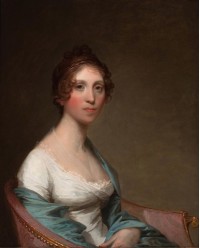
The lovely portrait of Eliza is by Gilbert Stuart (1809) and can be found here. The quoted passage appears on page 296 of In the Words of Women.

posted July 18th, 2013 by Janet, Comments Off on “The whole city was one scene of triumphal rejoicing.”, CATEGORIES: New York, Washington, George

“an intense ambition to be at the head of my class”

Catharine Maria Sedgwick of Stockbridge, Massachusetts, was a widely read novelist during her lifetime. She was the daughter of Theodore Sedgwick, a prominent lawyer, judge, and politician, and Pamela Dwight of the renown New England family. Persuaded to recall her “fragmentary childhood” in the late 1790s for her niece Alice, she began her Recollections with this paragraph.

My dear little Alice,— … If you live to be an old woman, as I now am, you may like to rake in the ashes of the past, and if, perchance, you find some fire still smouldering there, you may feel a glow from it. It is not till we get deep into age that we feel by how slight a tenure we hold on to the memories of those that come after us, and not till then that we are conscious of an earnest desire to brighten the links of the chain that binds us to those who have gone before, and to keep it fast and strong.

This is what she wrote about her education.

Education in the common sense I had next to none, but there was much chance seed dropped in the fresh furrow, and some of it was good seed, and some of it, I may say, fell on good ground. My father was absorbed in political life, but his affections were at home. My mother’s life was eaten up with calamitous sicknesses. My sisters were just at that period when girls’ eyes are dazzled with their own glowing future. I had constantly before me examples of goodness, and from all sides admonitions to virtue, but no regular instruction. I went to district schools … no one dictated my studies or overlooked my progress. I remember feeling an intense ambition to be at the head of my class, and generally being there. Our minds were not weakened by too much study; reading, spelling, and [Nathaniel] Dwight’s Geography were the only paths of knowledge into which we were led. Yes, I did go in a slovenly way through the first four rules of arithmetic, and learned the names of the several parts of speech, and could parse glibly. … I enjoyed unrestrained the pleasures of a rural childhood; I went with herds of school-girls nutting, and berrying, and bathing by moon-light, and wading by daylight in the lovely Housatonic that flows through my father’s meadows. …

Think of a girl of eight spending a whole summer working a wretched sampler which was not even a tolerable specimen of its species! But even as early as that, my father, whenever he was at home, kept me up and at his side till nine o’clock in the evening, to listen to him while he read aloud to the family [David] Hume, or Shakespeare, or Don Quixote, or [S. Butler’s] Hudibras! …

The walking to our school-house was often bad, and I took my lunch (how well I remember the bread and butter, and “nut-cakes,” and cold sausage, and nuts, and apples, that made the miscellaneous contents of that enchanting lunch basket!).

Works by Catharine Maria Sedgwick are listed here. The first paragraph of her memoir appears here. The description of her education is from In the Words of Women, pages 231-32.

posted July 15th, 2013 by Janet, Comments Off on “an intense ambition to be at the head of my class”, CATEGORIES: Education, Sedgwick, Catharine Maria

next page

   Copyright © 2025 In the Words of Women.