The United States in 1784

Another “she-merchant”

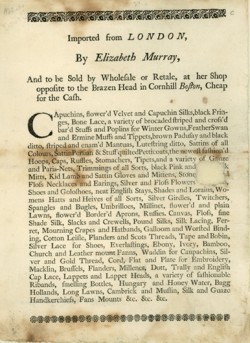
There were numbers of women shopkeepers in eighteenth-century America. And they used various ways to advertise their wares: ads in local newspapers (see Catherine Rathell) and trade cards (see Jane Eustis) among them. Elizabeth Murray, another enterprising woman, who opened a shop in Boston in 1749, circulated broadsides as well.

Having come from Scotland to live with her brother James in North Carolina when she was twelve, Elizabeth gained experience as his housekeeper and manager of his estate. She moved back to Scotland with James and his wife but returned to America when she was twenty-two and set up shop in Boston. Her business prospered to the point where she was self-sufficient. And she was careful to maintain her financial independence when she married by insisting upon a prenuptial agreement with each of her three husbands. More about her in the next post.

The broadside image was taken from the Elizabeth Murray Project at the University of California and can be found at the Massachusetts Historical Society.

posted August 29th, 2013 by Janet, Comments Off on Another “she-merchant”, CATEGORIES: Boston, Employment, Fashion

“All Cheap for Cash”

Jane Eustis, a shopkeeper in Boston, advertised her wares by means of a trade card, known at the time as a shopkeeper’s bill. What is also interesting about this particular example is that on the back is a record of a customer’s purchases from April 1769.

The information about Jane Eustis comes from The Elizabeth Murray Project at California State University. The trade card is at the American Antiquarian Society in Worcester, Massachusetts.

posted August 26th, 2013 by Janet, Comments Off on “All Cheap for Cash”, CATEGORIES: Boston, Clothes, Employment, Fashion, London

“fashionable, new and good”

In the American colonies during the eighteenth century some enterprising women were shopkeepers. Advertisements they placed in newspapers give an idea of the sorts of things that were for sale and what the current fashions were. Catherine Rathell had quite a stock of fancy imported goods as this ad in the Virginia Gazette in 1768 attests.

Just imported from London and selling by the subscriber, at a low advance for ready money only, the following articles, viz.

Flowered satin and spotted mode cardinals and cloaks; hats and bonnets; gauze and lace; plain, striped, and book muslins; fine thick cambrics and clear lawns; bordered handkerchiefs; a large and fashionable assortment of ribbons, caps, egrets, plumes, feathers and fillets; exceeding fine lappet beads*; a neat assortment of garnet, paste, and other rings; shoe, knee, and stock buckles; silver mounted Morocco pocket books with instruments, and some very complete and secure with two locks; housewives [housewares?] for ladies with instruments; satin caps of all sizes, white, black, and colored silk hose; fine India cotton [hose] and worsted [hose], boys’ and girls’ worsted [hose]; Disbury’s best shoes and pumps for gentlemen; red, blue, and yellow slippers for [gentlemen]; Disbury’s best and neatest black and white satin and callimanco** pumps.

For ladies, a very neat and genteel assortment of wedding, mourning and second mourning, and children’s shoes of all sizes, artificial hair pins, breast flowers equal in beauty to any ever imported, and so near resembles nature, that the nicest eye can hardly distinguish the difference; colored and white silk French kid, lamb gloves and mitts for ladies, girls, and children; buck, doe, kid lamb and white gloves for gentlemen; black silk bags and roses for [gentlemen]; blond, silk, and cotton thread for working; sewing silks of all sorts and paper pins; needles sorted; fine plaited stocks and stock tapes; quilted petticoats and red cardinals***, garlands, and trimmings; walking sticks, canes, with many other items too numerous to mention.

As the above goods are fashionable, new and good, she hopes to meet with encouragement, which shall be most thankfully acknowledged by
Catherine Rathell * beads for a decorative flap usually on a headdress
** a worsted glazed cloth
*** a short hooded cloak, usually of scarlet cloth, worn by women in the eighteenth century.

The source for the advertisement is Sylvia R. Frey and Marian J. Morton New World, New Roles—A Documentary History of Women in Pre-Industrial America (Westport, Connecticut: Greenwood Press, 1986), pages 162-63.

posted August 22nd, 2013 by Janet, Comments Off on “fashionable, new and good”, CATEGORIES: Clothes, Employment, Fashion, London

“a tongue for the dumb”

In 1856, Benjamin Drew, a Boston abolitionist, published a book called The Refugee: Narratives of Fugitive Slaves In Canada. He had made a trip through Canada in the early 1850s, sponsored by the Anti-Slavery Society of Canada and the publisher of Uncle Tom’s Cabin, to interview slaves from the United States who had fled to Canada as fugitives or were kidnapped and sold there. It has been estimated that there were about 30,000 such persons in Canada in 1852. As stated in the Preface: “While his informants talked, the author wrote: nor are there in the whole volume a dozen verbal alterations which were not made at the moment of writing, while in haste to make the pen become a tongue for the dumb.” However, the usual cautions about oral history apply. Presented here is the account by Sophia Pooley, who had been a slave of Joseph Brant, the Mohawk military and civilian leader who supported the British during the American Revolution.

I was born in Fishkill, New York State, twelve miles from North River. My father’s name was Oliver Burthen, my mother’s Dinah. I am now more than ninety years old. I was stolen from my parents when I was seven years old, and brought to Canada; that was long before the American Revolution. There were hardly any white people in Canada then—nothing here but Indians and wild beasts. . . .

My parents were slaves in New York State. My master’s sons-in-law, Daniel Outwaters and Simon Knox, came into the garden where my sister and I were playing among the currant bushes, tied their handkerchiefs over our mouths, carried us to a vessel, put us in the hold, and sailed up the river. I know not how far nor how long—it was dark there all the time. Then we came by land. I remember when we came to Genesee—there were Indian settlements there—Onondagas, Senecas, and Oneidas. I guess I was the first coloured girl brought into Canada. The white men sold us at Niagara to old Indian Brant, the king. I lived with old Brant about twelve or thirteen years as nigh as I can tell. . . .

Canada was then filling up with white people. And after Brant went to England, and kissed the queen’s hand, he was made a colonel. Then there began to be laws in Canada. Brant was only half Indian: his mother was a squaw—I saw her when I came to this country. She was an old body; her hair was quite white. Brant was a good-looking man—quite portly. . . . He lived in an Indian village—white men came among them and they intermarried. . . . When Brant went among the English, he wore the English dress—when he was among the Indians, he wore the Indian dress—broadcloth leggings, blanket, moccasins, fur cap. He had his ears slit with a long loop at the edge, and in these he hung long silver ornaments. reason of his going about so much. I used to talk Indian better than I could English. I have forgotten some of it—there are none to talk it with now.

Brant’s third wife, my mistress, was a barbarous creature. She could talk English, but she would not. She would tell me in Indian to do things, and then hit me with anything that came to hand, because I did not understand her. I have a scar on my head from a wound she gave me with a hatchet; and this long scar over my eye, is where she cut me with a knife. . . . Brant was very angry, when he came home, at what she had done, and punished her as if she had been a child. Said he, “you know I adopted her as one of the family, and now you are trying to put all the work on her.”

continue reading…

posted August 19th, 2013 by Janet, Comments Off on “a tongue for the dumb”, CATEGORIES: Canada, Indians, Slaves/slavery

“a General Clamor arose among the common soldiery”

Having declared independence in 1776, the Continental Congress had to raise a national army, in addition to the state militias, to fight for that independence. Many men volunteered fueled by a rush of patriotism. To continue to attract volunteers Congress promised them pay, food, clothing, and land after 84 months of service. But since Congress was a creature of the states it lacked the power to compel them to honor these commitments. There was profiteering, as is common in war, and supplies and equipment, when provided, were often substandard. Worst of all, failure to pay soldiers in a timely fashion meant hardships for their families to whom they had been sending money.

In 1779, soldiers of the 2nd North Carolina Continental Line, unpaid for several months, malnourished, and ill-equipped, led by Sergeant Samuel Glover, refused an order to march south to defend Charleston. Despite the fact that their complaint was against the civilian authority which had defaulted on its promises, their action was a violation of military regulations, technically mutiny. As an example to the other soldiers, Glover was executed on February 23, 1780. His wife Ann applied to the General Assembly of North Carolina for public assistance for herself and her two children.

State of North Carolina
To the Honorable the General Assembly of the said State now sitting.
The Humble Memorial of Ann Glover, widow of Samuel Glover . . . Humbly Sheweth, That your Petitioner’s late Husband well and faithfully discharged his Duty as a Soldier and Friend to the Cause of American freedom and Independence, & marched to the Northward under the Command of Col. Robert Howe, who, if he was here, would bear honest and honorable Testimony that your Memorialist’s deceased Husband was deemed by him and every other officer in that Battalion a good soldier, and never was accused of being intentionally Guilty of a breach of the Laws, Martial or Civil. Your Petitioner begs leave to inform your Honors that her late husband continued in the service of the United States of America upwards of three years, and then returned, by orders of his Commanding officers, to the Southward, at which time he had above twelve month’s pay due for his services as a soldier, and which he ought to have received, and would have applyed for the sole support of himself, his wife, your Petitioner, and two helpless orphan Children. That many of the poor soldiers then on their March . . . possessed of the same attachment & affection to their Families as those in Command, but willing to endure all the dangers and Hardships of war, began their March for the Defence of the State of South Carolina, could they have obtained their promised but small allowance dearly earned for the support of their distressed families in their absence; but as they were sure of suffering for want of that subsistance which at that time & unjustly was cruelly withheld from them, a General Clamor arose among the common soldiery, and they called for their stipend allowed by Congress, but it was not given them, altho’ their just due. Give your poor Petitioner leave to apologize for her unhappy Husband’s conduct & in behalf of her helpless self, as well as in Favour of his poor Children on this occasion, and ask you what must the Feeling of the Man be who fought at Brandywine, at Germantown, & at Stony Point & did his duty, and when on another March in defence of his Country, with Poverty staring him full in the face, he was denied his Pay? His Brother soldiers, incensed by the same Injuries and had gone through the same services, & would have again bled with him for his Country whenever called forth in the service, looked up to him as an older Soldier, who then was a Sergeant, raised by his merit from the common rank, and stood forth in his own and their behalf, & unhappily for him demanded their pay, and refused to obey the Command of his superior Officer, and would not march till they had justice done them. The honest Labourer is worthy of his hire. Allegiance to our Country and obedience to those in authority, but the spirit of a man will shrink from his Duty when his Services are not paid and Injustice oppresses him and his Family. For this he fell an unhappy victim to the hard but perhaps necessary Law of his Country. The letter penned by himself the day before he was shot doth not breathe forth a word of complaint against his cruel Sentence, Altho’ he had not received any pay for upwards of fifteen months. He writes to your Humble Petitioner with the spirit of a Christian. This Letter is the last adieu he bid to his now suffering widow, & she wishes it may be read in public Assembly . . . . Your humble Petitioner, distressed with the recollection of the fatal catastrophe . . . humbly request[s] that you will extend your usual Benevolence & Charity to her & her two children, and make her some yearly allowance for their support.
I am, &c
Ann Glover
New Bern, 10th Jan. 1780

It is unclear whether Ann Glover’s petition was granted.

Glover’s petition is included in Walter Clark, ed., The State Records of North Carolina (Goldsboro: Nash Bros. Book and Job Printers, 1898), vol.15, pages 187-88. A somewhat abbreviated version can be found on pages 146-47 of In the Words of Women. An excellent reference is Michael A. Bellesiles, A People’s History of the US Military: Ordinary Soldiers Reflect on Their Experience of War, from the American Revolution to Afghanistan (New York City: The New Press, 2012), pages 19-21.

posted August 15th, 2013 by Janet, comments (2), CATEGORIES: American soldiers, Military Service

next page

   Copyright © 2025 In the Words of Women.