New York Diaries

“City Room” is one of the blogs that appear on the New York Times website, featuring stories of interest to New Yorkers. Sometimes a blog post will make it to the paper itself. The post here is based on the book New York Diaries: 1609-2009 by Teresa Carpenter. Rightly acclaimed, it is a collection of the ordinary and extraordinary deftly woven into a history of the city. City Room has taken the book to another level, however, by locating the originals of several of the entries and presenting them on the post to be pored over by readers in an “interactive” document.

As an author/editor of In the Words of Women I have enjoyed tracking down the writings of Revolutionary Era women and handling manuscripts they have written; I have welcomed the challenge of reading and transcribing the handwriting of a variety of women. Thrills enough to sustain me through the more mundane tasks of organizing materials and preparing a camera-ready manuscript.

Kudos to the City Room editor for presenting these original documents allowing readers to share, in some small part, the excitement of examining the “raw materials of history.”

posted February 13th, 2012 by Janet, Comments Off on New York Diaries, CATEGORIES: Letter-writing, Reading old documents

“Excuse my tears …”

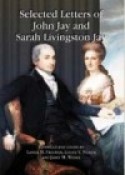
Sarah Livingston Jay had accompanied her husband John to Spain in 1779 when he was named minister plenipotentiary to that nation. Jay’s attempts to secure monetary support for the Revolution and recognition of the new nation were largely unsuccessful. Sarah, writing from Madrid to her mother in August 1780, described a wrenching personal tragedy that she and John had to cope with, away from family and friends, and in a foreign country.

Had I wrote to my dear Mamma a fortnight ago, while my whole heart overflowed with Joy & gratitude for the birth of a lovely daughter I am sure every line must have conveyed pleasure to the best of Parents, who well knows the affection of a mother. Every circumstance united in rendering that event delightful to us. Excluded the Society of our most intimate friends behold us in a Country whose customs, language & religion are the very reverse of our own, without connections, without friends, judge then if heaven could have bestowed a more acceptable present. … Every wish of my heart was amply answered in the precious gift, in her charming countenance I beheld at once the soften’d Resemblance of her father & absent brother, her little form was perfect symmetry. … When I used to look at her every idea less pleasant vanish’d in a moment. … and while I clasp’d her to my bosom my happiness appear’d compleat &c. Alas! Mamma, how frail are all sublunary enjoyments! But I must endeavor to recollect myself.

On Monday the 22d day after the birth of my little Innocent, we perceived that she had a fever, but were not apprehensive of danger until the next day when it was attended with a fit. On Wednesday the Convulsions increas’d, and on thursday she was the whole day in one continued fit; nor could she close her little Eye-lids till friday morng the 4th of Augst. at 4 Clock when wearied with pain the little sufferer found rest in _____. Excuse my tears—you too mamma have wept on similar occasions, maternal tenderness causes them to flow & reason, tho’ it moderates distress, cannot intirely restrain our grief, nor do I think it should be wish’d. For why should Heaven (in every purpose wise) have endowed its lovely Messenger with so many Graces but to captivate our hearts & excite them by a contemplation on the beloved object of our affection, to rise above those expectations that rather amuse than improve & extend our views even to those regions of bliss where she has arrived before us. While my mind continues in its present frame I look upon the tribute my child has paid to nature as the commencement of her immortality, & endeavour to acquiesce in the dispensations of the all-wise disposer of events; & if my heart continues in proper subjection to the divine will, then will she not have sicken’d, not have dy’d in vain.

This excerpt is from Selected Letters of John Jay and Sarah Livingston, compiled and edited by Landa M. Freeman, Louise V. North, and Janet M. Wedge, published in 2005 by MacFarland & Company, pages 90-91.

posted February 9th, 2012 by Janet, Comments Off on “Excuse my tears …”, CATEGORIES: Americans Abroad, Children, Death, Health

“Where sleeps the Virtue & Justice of the English Nation?”

English-born Esther DeBerdt married American lawyer Joseph Reed in London and moved with him to Philadelphia in 1770. When hostilities began, her husband became an aide to General Washington and was therefore apart from his family a good deal. Writing to her brother in England, Esther reveals herself as a staunch supporter of the American cause.

Amboy Septr 8th 1775You will see by the date of this my dear Dennis that I am from home; the health of my dear Girl which always suffers in the Summer Months was the Chief reason of my coming here. I find it very beneficial to her & pleasant for myself—I received yours of the 20 & 21st of June. The News they contained tho’ not very material I sent to my dr Mr. R at the Camp. He is yet there amidst all the confusion & horrors of War, before this time you knew our dreadful situation, here indeed & every Southern Province. We only here the Sound, but it is such a one, as sometimes shakes my firmness & resolution, but I find the human Mind can be habituated to all most anything, even the most distressing Scenes, after a while become familiar.

I am happy that Mr. R’s situation at the Camp is the most eligable he coud have been placed in, his accomodations, with the General [Washington], in his Confidence, & his Duty in the Councils, rather than the Field. While his person is safe from danger I chearfully give up his profitts in Business (which were not trifling) & I acquies without repining at his being so long absent from me. I think the Cause in which he is engaged so just, so Glorious & I hope will be so victorious that private interest & pleasure may & ought to be given up without a murmur.

But where sleeps all our Friends in England? Where sleeps the Virtue & Justice of the English Nation? will nothing rouse them? or are they so few in Number & small in Consequence that tho’ awake, their voice cannot be heard for the multitude of our Enemies—how strange woud this Situation of things have appeared even in Prospect a few years ago? coud we have forseen it when we parted in England it would probably have prevented that Seperation. We might often, if we coud forsee Events provide against approaching evils, but I believe it is right we shoud not, for tho our private happiness might have been promoted, yet our Country woud not been benefited, for at this time she requires all her friends & has a right to expert services from such heads & hearts as can most conduce to her Safety. We impatiently wait to hear what effect the Battle of Bunker Hill has both on our friends & Enemies. A few weeks I suppose will let us know. …

I take it for granted that I am writing to some curious person in office & that my Letter, insignificant as it is, will be open’d before you get it. One from Mr. Lane Secry of the Jersey Society to Mr. R came here with the seal quite broke as if it was done on purpose to shew they dare & woud do it.

I hope it is no Treason to say I wish well to the cause of America tho’ guess Treason is not now tho’t much of—however I am safe in telling you how much my love is kept alive tho’ at this distance & with what undiminished Affectn I am Ever truly Yours,
No Reason sign name now

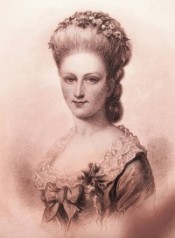
The excerpt is from In the Words of Women, Chapter 4, pages 95-96. The portrait is by Charles Willson Peale.

posted February 6th, 2012 by Janet, Comments Off on “Where sleeps the Virtue & Justice of the English Nation?”, CATEGORIES: Censorship, Mail, Military Service, Patriots, Philadelphia, Reed, Esther De Berdt, Reed, Joseph, Resistance to British, Washington, Martha

“No respite can I gain”

Annis Boudinot Stockton was one of the best known and accomplished poets in eighteenth century America. The wife of Richard Stockton, a prominent lawyer, delegate to the Continental Congress, and signer of the Declaration of Independence, she presided over their home called “Morven,” near Princeton. During the Revolution the British ransacked Stockton’s estate, destroyed his library, drove off his stock, and took him prisoner. The ill effects of captivity and the stress of financial impoverishment took their toll on Stockton’s health, and he succumbed to cancer in 1781. “Confined to the chamber of a dear and dying husband,” Annis gave voice to her grief in this poem:


I.
Sleep, balmy sleep, has clos’d the eyes of all
But me! ah me! no respite can I gain;
Tho’ darkness reigns o’er the terrestrial ball,
Not one soft slumber cheats this vital pain.
. . . . . . . . . . . . . . . . . . . . . . . . . . . . . . . . . . . .
III.
While through the silence of this gloomy night,
My aching heart reverb’rates every groan;
And watching by that glimmering taper’s light,
I make each sigh, each mortal pang my own.
IV.
But why should I implore sleep’s friendly aid?
O’er me her poppies shed no ease impart;
But dreams of dear departing joys invade,
And rack with fears my sad prophetick heart.
V.
But vain is prophesy when death’s approach,
Thro’ years of pain, has sap’d a dearer life,
And makes me, coward like, myself reproach,
That e’er I knew the tender name of wife.
VI.
Oh! could I take the fate to him assign’d!
And leave the helpless family their head!
How pleas’d, how peaceful, to my lot resign’d,
I’d quit the nurse’s station for the bed.
. . . . . . . . . . . . . . . . . . . . . . . . . . . . . . .

This excerpt is from In the Words of Women, Chapter 7, page 201. For information about Morven, click here.

posted February 2nd, 2012 by Janet, Comments Off on “No respite can I gain”, CATEGORIES: British soldiers, Death, Looting, Marriage, Prisoners

previous page

   Copyright © 2026 In the Words of Women.