Nanyehi

Nanye’hi was a Cherokee woman born in the early 1700s in what is today eastern Tennessee. Women played an important role in the affairs of the Cherokee nation since kinship was matrilineal, and its agricultural economy was based on the labor of women. When Nanye’hi’s husband was killed in a battle with neighboring Creeks, she took his place and fought until they were driven off. Afterwards referred to as Ghighau, which translates as War Woman or Beloved Woman, she was held in high regard and was entitled to participate in political and ceremonial life and determine the fate of captives. When she married a white trader, Nanye’hi became known as Nancy Ward. She assumed the role of female ambassador in negotiations with the United States in 1781 which pressed the Cherokees for land concessions. Reminding the United States Commissioners that many Cherokees had supported the Americans during the Revolution, her plea was successful and no Cherokee land was ceded at that time. Unfortunately the Indians were eventually dispossessed and forced into western exile.

You know that women are always looked upon as nothing; but we are your mothers; you are our sons. Our cry is all for peace; let it continue. This peace must last forever. Let your women’s sons be ours, our sons be yours. Let your women hear our words.
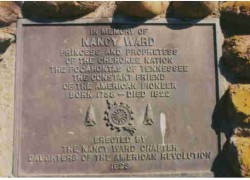
Not long after her death, the Cherokees, adopting the values and life-styles of Anglo-Americans, withdrew rights that had previously been accorded to women. Nevertheless Nancy Ward was not forgotten. This memorial was erected over her grave by the Daughters of the American Revolution.

posted September 10th, 2012 by Janet, Comments Off on Nanyehi, CATEGORIES: Indians

“Oh! How many wretched families were made that day.”

Mary Gould Almy, with her children and mother, lived in Newport, Rhode Island during its occupation by the British (1776-1779). As happened in so many families, the Revolution divided husband and wife. Mary opposed the war while her husband Benjamin sided with the Americans, serving under General John Sullivan. Having signed a treaty of alliance with the Americans, France sent a fleet under Count d’Estaing to Newport in July 1778, to prepare for a joint assault on that city with the Americans. Almy described for her husband what took place. She explained her motivation for keeping a record.

By your desire and my own inclination, I am to give you an account of what passes during the siege; but first let me tell you, it will be done with spirit, for my dislike to the nation that you call your friends, is the same as when you knew me, knowing there is no confidence to be placed in them, and I foresee that the whole will end, as this maneuvere did, in taking this island, to the discredit of the Americans. You will not be surprised at my warmth when you will find how I suffered, nor wonder at my freedom when you find this comes sealed and wrote for your perusal alone.

Saturday August 8.
At one o’clock, signals for unmooring throughout the French fleet, a brisk gale blew, and entirely fair. One hour, the longest time that could be thought, then we should all be prisoners. Heavens! what distress! what consternation seize me! where to fly for shelter! … Then that precious comforter to the female, came to my relief, a silent shower of tears behind the haystack, for my poor friends in town, who never were in half the danger as myself, and cousin C.’s cherry rum being brought, I grew more and more enabled to bear my sorrows.

Sunday, August 16.
Still carting, still fortifying; your people encroaching nearer, throwing up new works every night. Our people beholding it every morning, with wonder and astonishment. And … my curiosity was so great, as to wish to behold the entrenchment that I supposed you were behind; and a good young man … took me in a chaise to the hospital … [where] we had an excellent view of … all the encampments around it. Believe me, my dear friend, never was a poor soul more to be pitied, such different agitation as by turns took hold upon me. Wishing most ardently to call home my wanderer, at the same time, filled with resentment against those he calls his friends, so that I returned home more distressed, my spirits more sunk than when I went out.

Monday, August 17.
Nothing happened worth notice. … the day was spent in exchanging shots; in the evening they entertained us with throwing shells. It would have been an agreeable sight, had we not been sure it was meant to carry death along with it. I sat upon the top of the house till twelve, beholding and admiring the wonderful contrivances of mankind to destroy one another.

continue reading…

posted September 6th, 2012 by Janet, Comments Off on “Oh! How many wretched families were made that day.”, CATEGORIES: Battles, British soldiers, Hessians, Loyalists, Marriage, New England, Patriots

” … purchase me a bundle of pins … “

This excerpt is the end of a letter (16 June 1775) that Abigail Adams, in Weymouth, wrote to John who was in Philadelphia attending the Continental Congress.

I have a request to make you. Something like the Barrel of Sand suppose you will think it, but really of much more importance to me. it is that you would send out Mr. Bass & purchase me a bundle of pins & put in your trunk for me—the cry for pins is so great that what we used to Buy for 7.6 are now 20 Shillings & not to be had for that. a bundle contains 6 thousand for which I used to give a Dollor—but if you can procure them for 50 [shillings] or 3 pound, pray let me have them—Mr Welch who carries this to head Quarters awaits which prevents my adding more than that I am with the tenderest Regard
your Portia

Reading this passage for the first time I tried to imagine what Abigail wanted pins for. I assumed they had something to do with sewing clothing. I didn’t realize that they were “dress pins” used to fasten garments together while they were being worn. Women of this period usually wore several layers of clothing. There was first of all a loose shift (which served as an undergarment), overlaid with stays, and perhaps a padded hoop, after which came one or more petticoats, and then a gown open at the front (revealing the petticoat) with a bodice with sleeves, or perhaps removable ones. Gowns often featured stomachers, stiffened, triangular decorative panels designed to cover gaps, smooth the front of the bodice, and accentuate the cone shape of the upper body. How were these garments held together? There were of course buttons, hooks and eyes, and laces, but these were bulky solutions and not suitable for all purposes. Remember there were no safety pins (not invented until 1849), or snap fasteners (1885), or zippers (1893), not to speak of Velcro. The answer is that garments were fastened together with straight pins, inserted vertically at the seams to be virtually invisible, and shallowly so as not to prick the skin. Sometimes the pins were brass as these did not rust, but steel was preferred because points were sharper. They usually came in paper packets of two or three dozen. (Interestingly straight pins have been found in archaeological digs as fasteners for shrouds of corpses.) During the Revolution pins were in short supply as they were imported from Britain, hence the increase in price referred to in Abigail’s letter.

I finally pinned this one down!

Sources: Adams Electronic Archive, letter of Abigail Adams to John Adams, 16 June 1775.

posted September 3rd, 2012 by Janet, Comments Off on ” … purchase me a bundle of pins … “, CATEGORIES: Adams, Abigail, Clothes, Fashion

previous page

   Copyright © 2026 In the Words of Women.