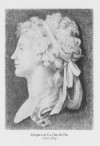
“On paper, the portrait will not be flattering”

Henriette Lucie Dillon de La Tour du Pin Gouvernet returned to France from the United States with her family when her husband’s lands had been restored to him after the French Revolution. From the journal she kept during her lifetime, including her stay in America, she put together a fascinating memoir. This is the way she described herself as a marriageable young woman.

On paper, the portrait will not be flattering, for my reputation for beauty was due entirely to my figure and my bearing, not at all to my features.

My greatest beauty was my thick ash-blond hair. I had small grey eyes and my eyelashes were very thin, partly destroyed when I was four by a bad attack of smallpox. I had sparse, fair eyebrows, a high forehead and a nose often described as Grecian, but long and too heavy at the tip. My best feature was my mouth, for my lips were well shaped and had a fresh bloom. I also had very good teeth. Even today, at the age of seventy-one, I still have them all. I was said to have a pleasant face and an attractive smile, yet in spite of that, my appearance might have been considered ugly. I am afraid a number of people must have thought so, for I myself considered hideous certain women said to resemble me. But my height and my good figure, my dazzlingly clear and transparent complexion made me outstanding in any gathering, particularly by day, and I certainly overshadowed other women endowed with far better looks than mine.

Recollections of the Revolution and the Empire, edited and translated by Walter Geer (New York: Brentano’s, 1920), pages 33-34.

posted December 13th, 2012 by Janet, Comments Off on “On paper, the portrait will not be flattering”, CATEGORIES: France

The Shakers

Madame du Pin (see previous post), the French aristocrat who, with her husband and children, had fled to the United States in 1794, adjusted amazingly well to life on a farm near Albany. A sect called the Shakers—they worshiped by ecstatic dancing or “shaking”, hence the name Shaking Quakers or Shakers—living nearby in Niskayuna, now Watervliet, interested her, and she arranged to be taken with her husband on a tour of their property.

A nice wagon, loaded with fine vegetables, often passed before our door. It belonged to the Shakers, who were located at a distance of six or seven miles. The driver of the wagon always stopped at our house, and I never failed to talk with him about their manner of life, their customs, and their belief. He urged us to visit their establishment, and we decided to go there some day. It is known that this sect of Quakers belonged to the reformed school of the original Quakers who took refuge in America with Penn.

After the war of 1763, an English woman [Ann Lee] set herself up for a reformer apostle. She made many proselytes in the states of Vermont and Massachusetts. Several families put their property in common and bought land in the then uninhabited parts of the country. … Those of whom I speak were then protected on all sides by a forest several miles deep. This establishment was a branch of their headquarters at Lebanon [New York]. …

We came out in a vast clearing traversed by a pretty stream and surrounded on all sides by woods. In the midst was erected the establishment, composed of a large number of nice wooden houses, a church, schools, and a community house of brick. The Shakers … greeted us with kindness, although with a certain reserve. … We had been advised that nobody would offer us anything, and that our guide would be the only one to speak to us. He first led us to a superb kitchen-garden perfectly cultivated. Everything was in a state of the greatest prosperity, but without the least evidence of elegance. Many men and women were working at the cultivation or the weeding of the garden. The sale of vegetables represented the principal source of revenue to the community.

We visited the schools for the boys and girls, the immense community stables, the dairies, and the factories in which they produced the butter and cheese. Everywhere we remarked upon the order and the absolute silence. The children, boys and girls alike, were clothed in a costume of the same form and the same color. The women of all ages wore the same kind of garments of gray wool, well kept and very neat. Through the windows we could see the looms of the weavers, and the pieces of cloth which they were dyeing, also the workshops of the tailors and dress-makers. But not a word or a song was to be heard anywhere. …

Having … visited all parts of the establishment, we took leave of our kind guide and entered our wagon to return home. …

This description appears on page 311 of In the Words of Women. Recollections of the Revolution and the Empire From the French of the “Journal D’une Femme de Cinquante Ans”. was written about 1843 and first published in 1906, edited and translated by Walter Geer (New York: Brentano’s, 1920), p. 214 ff. The photograph of the headstone of Mother Ann Lee comes from this SITE.

posted December 10th, 2012 by Janet, Comments Off on The Shakers, CATEGORIES: Farming, New York, Religion, Shakers

“the last survivors of the Mohawk tribe””

Henriette-Lucie Dillon de La Tour du Pin de Gouvernet, her husband the Comte, and their two children, fled France in 1794 to avoid the fate of many aristocrats—the guillotine. They managed to make a life in America, buying a farm not far from Albany, New York. Henriette-Lucie kept a journal on which she based her memoirs. As winter set in, they had their first encounter with the Indians.

We had acquired moccasins, a kind of foot-covering of buffalo-skin, made and sold by the Indians. The price of these articles was sometimes quite high when they were embroidered with dyed bark or with porcupine quills. It was in purchasing these moccasins that I saw the Indians for the first time. They were the last survivors of the Mohawk tribe whose territory had been purchased or taken by the Americans since the peace. The Onondagas, established near Lake Champlain, also were selling their forests and disappearing at this epoch. From time to time some of them came to us.

In 1795 with the coming of spring, the Indians reappeared.

One of them, at the beginning of the cold weather, had asked my permission to cut some branches of a kind of willow tree which had shoots, large as my thumb and five or six feet long. He promised me to weave some baskets during the winter season. I counted little upon this promise, as I did not believe that Indians would keep their word to this degree, although I had been so informed. I was mistaken. Within a week after the snow had melted, my Indian came back with a load of baskets. He gave me six of them which were nested in one another. The first, which was round and very large, was so well made that, when filled with water, it retained it like an earthen vessel. I wished to pay him for the baskets, but he absolutely refused and would accept only a bowl of buttermilk of which the Indians are very fond. I was very careful not to give my visitors any rum, for which they have a great liking. But I had in an old paste-board box some remnants (artificial flowers, feathers, pieces of ribbons of all colors and glass beads, which were formerly much in vogue) and I distributed these among the squaws, who were delighted with them.

The above passages can be found on pages 310 -11 of In the Words of Women. The illustration can be found on this SITE.

posted December 6th, 2012 by Janet, Comments Off on “the last survivors of the Mohawk tribe””, CATEGORIES: French Revolution, Indians, New York

“This peace brings none to my heart”

Late in 1782, the Preliminary Articles of the peace treaty, which John Jay had helped negotiate, were agreed to in Paris. Sarah Jay wrote her father: “The dawn of peace seems to approach.” She congratulated him on the prospect. She also expressed her personal joy to her sister Kitty in Philadelphia anticipating, at long last, a reunion with her family. “Oh! Kitty perhaps the time draws near when we shall fold each other to our bosoms, and when our domestic felicity shall again be compleat.”
The Treaty of Paris, signed the next year, ended the Revolutionary War. There was great rejoicing in the new nation, but not everyone had cause to celebrate. Sarah Winslow, sister of loyalist Edward Winslow, wrote to her cousin Benjamin Marston in Canada of the family’s bitterness at their treatment by the Americans and what they considered betrayal by the British government.

April 10—1783, New YorkWhat is to become of us, God only can tel, in all our former sufferings we had hope to support us, being depriv’d of that, is too much, my mind, and strength, are unequal to my present, unexpected tryals—was their ever an instance my dear Cousin, can any history produce one where such a number of the best of human beings were deserted by the Government they have sacrific’d there all for.

The open enemys of Great Britain have gaind there point. … This peace brings none to my heart, my Brother . . . is now hasting away—may he meet you upon his arrival in Halifax. … You my Cousin I hope will be much with him. … Let compassion and friendship induce you to inform me always when you can, of his situation, and health, and do my friend as you value the peace of this fam-ily caution him to take care of himself. …

Here it thought best for us to continue for some months or until it is known what better we can do. Severe are the struggles I must now dayly have with myself. … I wish to retire entirely to my own family, and endeavour to remain unmolested, if possible, for which purpose my Brother is now seecking a house for us out of the City. …

This servant will make you a partaker of our sufferings … you are a Christian and Phylosopher, teach me so to be … your affectionate Cousin S

Sarah Jay’s remarks and the letter of Sarah Winslow are from In the Words of Women, pages 289-90.

posted December 3rd, 2012 by Janet, Comments Off on “This peace brings none to my heart”, CATEGORIES: Americans Abroad, Independence, Loyalists, Paris

previous page

   Copyright © 2025 In the Words of Women.