When George Washington decided it was time to settle down he courted and married Martha Dandridge Custis, a wealthy young widow. It was a long and happy marriage although the pair had no children of their own.
By her first husband Daniel Parke Custis, Martha had a son, John Parke Custis, who married Eleanor Calvert. The couple had four children. When John died, the two older daughters, Elizabeth (Betsey) and Martha (Patsy) remained with their mother who remarried. The other two children, Eleanor (Nelly) and George Washington Parke, were formally adopted by George Washington and lived with their grandparents, although they often enjoyed extended visits with their mother.
George Washington was a loving grandfather to his wife’s progeny. He even went so far as to offer the girls advice on love and marriage. In a departure from this blog’s emphasis on the writings of women during the Revolution and beyond, this post includes excerpts from a letter George Washington wrote to Nelly, the attractive and popular young woman who enjoyed the social whirl. I love this letter written by Washington at Philadelphia to Nelly at Mount Vernon where she was to spend the summer; it goes far to soften popular image of Washington as the stern, starchy general and first president.
Philadelphia 21st Mar. 1796My dear Nelly,
…. A hint here; men & women feel the same inclinations towards each other now that they always have done, and which they will continue to do until there is a new order of things. And you, as others have done, may find perhaps, that the passions of your sex are easier roused than allayed. Do not therefore boast too soon, nor too strongly, of your insensibility to, or resistance of its powers.
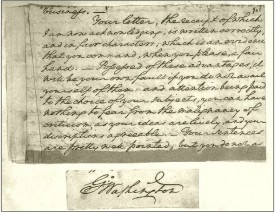 In the composition of the human frame there is a good deal of inflaminable matter; however dormant it may be for a while, and, like an intimate acquaintance of yours, when the torch is put to it, that which is within you may burst into a blaze; for which reason, and especially too, as I have entered on the chapter of advices I will read you a lecture drawn from this text.
Love is said to be an involuntary passion and it is therefore contended that it cannot be resisted. This is true, in part only; for like all things else when nourished and supplied plentifully with [aliment,] it is rapid in its progress; but let these be withdrawn and it may be stifled in its birth or much stunted in its growth.
For example–a woman (the same with the other sex) all beautiful & accomplished will, while her hand & heart are undispared of [turn] the heads, and set the Circle in which [s]he moves on him.
Let her marry, and what is the consequence? The madness ceases and all is quiet again: Why? not because there is any diminuation in the charm[s] of the lady but because there is an end of hope. Hence it follows that love may and therefore that it ought to be under the guidance of reason. For although we cannot avoid first impressions, we may assuredly place them under guard; and my motives in treating on this subject are to show you, “whilst you remain Eleanor [Parke] Custis Spinster, and retain the resolution to love with moderation” the propriety of adhering to the latter; at least until you have secured your game, and the way by which it is to be accomplished.
When the fire is beginning to kindle, and your heart growing warm, propound these questions to it. Who is the invader? Have I competent knowledge of him? Is he a man of good character? A man of sense? For be assured a sensible woman can never be happy with a fool. What has been his walk in life? Is he a gambler? a spendthrift, a drunkard? Is his fortune sufficient to maintain me in the manner I have been accustomed to live, and my sisters do live? and is he one to whom my friends can have no reasonable objection? If these interrogations can be satisfactorily answered there will remain but one more to be asked; that however is an important one. Have I sufficient ground to conclude that his affections are enjoyed by me? Without this, the heart of sensibility will struggle against a passion that is not reciprocated; delicacy, custom, or call it by what epithet you will having precluded all advances on your part, the declaration without the most indirect invitation on yours must proceed from the man to render it permanent & valuable. And nothing short of good sense, and an easy unaffected conduct can draw the line between prudery & coquetry ….
[B]est regards are presented to your Mama, Dr. Stuart & family, and every blessing, among which a good husband when you want & deserve one, is bestowed on you by Your affectionate
Go. Washington
The letter appeared in George Washington Parke Custis’s Recollections of Washington (Philadelphia, 1861), pages 41-44, and was reprinted in John C. Fitzpatrick’s Writings of Washington, vol. 34, pp. 91-93. There are fragments of the original manuscript in the Bodleian Library at Oxford University. A twentieth-century, typed transcript, apparently made by a private owner of the manuscript before it became fragmented, exists in the library of the Mount Vernon Ladies’ Association. A comparison shows that Custis silently emended his grandfather’s capitalization, spelling, and punctuation, and eliminated parts of the letter that did not pertain to the subject of love and marriage. The excerpts that appear in this post are taken from the copy of the original manuscript. The illustration can be found HERE.

Joshua Brookes, visiting Mount Vernon when Nelly was there described her: “She appeared to be about twenty, dressed in white sprig muslin tied around her waist with a skyblue silk cord with six round balls at the end, head-dress fillet round her head and hair hanging down in ringlets between three turns of the fillet; no powder, about 5ft 4 high, middling stature and size. Silk stockings. Black shoes with large roses. She appeared modest, well-bred, intelligent, and sensible, has a piercing eye, grecian nose, made judicious remarks and conversed with propriety.”