“A POETICAL EPISTLE … to her NIECE, upon her Marriage”

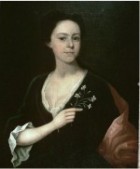
Annis Boudinot Stockton was well known for her patriotic verse during the Revolution, including one celebrating the end of the War in 1783 and several odes to George Washington. In 1985 a copybook of Stockton’s poems came to light titled Only for the Eye of a Friend. It was donated by Christine Carolyn McMillan Cairnes, a direct descendant of Annis Boudinot and Richard Stockton, to the New Jersey Historical Society. The newly found poems inspired scholar Carla Mulford to publish, in 1995, a collection of Stockton’s poems along with those recently discovered, using Stockton’s title. The following edited poem is interesting for the advice Stockton gives to her newly wed niece regarding appropriate behavior for a wife. You may be uncomfortable with what she recommends, but her advice is consistent with what was considered the proper role for a wife during the eighteenth century. Stockton signed it with the pen name she often used—Emilia.

A POETICAL EPISTLE, addressed by a LADY of New-
Jersey, to her NIECE, upon her Marriage, in this City.

Well! my lov’d Niece, I hear the Bustle’s o’er,
The wedding cake and visits are no more;
…………………………………………………………….
Now with your usual sweetness deign to hear,
What from a heart most friendly flows sincere:
…………………………………………………………….
Good nature—sense—of these you’ve ample store,
And Oeconomicks you have learnt before.
But there are lurking evils that do prove
Under the name of trifles—death to love.—
And from these trifles, all the jarring springs,
And trust me child, they’re formidable things.
First then—with rev’rence treat in ev’ry place,
The chosen patron of your future days;
For when you shew him but the least neglect,
Yourself you rifle of your due respect.—
……………………………………………………

Whene’er your husband means to stay at home,
Whate’er th’ occasion—dont consent to roam;
For home’s a solitary place to one
Who loves his wife, and finds her always gone.
At least consult the temper of his mind,
If vex’d abroad, he finds himself inclin’d
From public business to relax awhile;
How pleasing then the solace of a smile—
A soft companion to relieve his care,
His joy to heighten—or his grief to share?

Unbend his thoughts and from the world retire,
within his sacred home and round his chearful fire;
Nor let him know you’ve made a sacrifice,
He’ll find it out himself: And then he’ll prize
Your kind endeavors to promote his ease,
And make the study of your life to please.

Another rule, you’ll find of equal weight,
When jars subside, never recriminate;
And when the cloud is breaking from his brow,
Repeat not what he said—nor when nor how.
If he’s tenacious, gently give him way—
And tho’ ’tis night, if he should say, ’tis day—
Dispute it not—but pass it with a smile;
He’ll recollect himself—and pay your toil—
And shew he views it in a proper light;
And no Confusion seek—to do you right:
Just in his humour meet him—no debate,
And let it be your pleasure to forget.
His friends with kindness always entertain,
And tho’ by chance he brings them, ne’er complain;
whate’er’s provided for himself and you,
With neatness serv’d, will surely please them too.
…………………………………………………………….
But you, my dear—if you would wish to shine,
Must always say, your friends are also mine.
The house is your’s, and I will do the best,
To give a chearful welcome to each guest.

Nor are those maxims difficult to cope
When stimulated by so fair a hope,
To reach the summit of domestic bliss;
And crown each day with ever smiling peace.

Now if these lines one caution should contain.
To gain that end, my labor’s not in vain;
And be assur’d my dear, while life endures
With every tender sentiment, I’m your’s.
Emilia
The poem was printed in The Columbian Magazine 1 (November 1786), 143; MS, New Jersey Historical Society (dated October 19, 1784), also in Only for the Eye of a Friend: the Poems of Annis Budinot Stockton, edited with an introduction by Carla Mulford (University of Virginia Press, 1995) 134-37.

posted April 11th, 2013 by Janet, Comments Off on “A POETICAL EPISTLE … to her NIECE, upon her Marriage”, CATEGORIES: Daily life, Marriage

“My aching heart … “


Another selection for National Poetry Month, this one by Annis Boudinot Stockton. A talented poet, she was married to Richard Stockton, a prominent New Jersey lawyer and a signatory to the Declaration of Indepen-dence. The couple had been married 22 years when Richard developed cancer of the lip which spread to his throat. In 1781, while Annis watched with her husband in his last illness, she composed this poem.

I.
Sleep, balmy sleep, has clos’d the eyes of all
But me! ah me! no respite can I gain;
Tho’ darkness reigns o’er the terrestrial ball,
Not one soft slumber cheats this vital pain.
. . . . . . . . . . . . . . . . . . . . . . . . . . . . . . . . . . . .
III.
While through the silence of this gloomy night,
My aching heart reverb’rates every groan;
And watching by that glimmering taper’s light,
I make each sigh, each mortal pang my own.
IV.
But why should I implore sleep’s friendly aid?
O’er me her poppies shed no ease impart;
But dreams of dear departing joys invade,
And rack with fears my sad prophetick heart.
V.
But vain is prophesy when death’s approach,
Thro’ years of pain, has sap’d a dearer life,
And makes me, coward like, myself reproach,
That e’er I knew the tender name of wife.
VI.
Oh! could I take the fate to him assign’d!
And leave the helpless family their head!
How pleas’d, how peaceful, to my lot resign’d,
I’d quit the nurse’s station for the bed.
. . . . . . . . . . . . . . . . . . . . . . . . . . . . . . .

The poem can be found on page 200 of In the Words of Women. The portrait is attributed to Gerardus Duyckinck and is at the Princeton Museum of Art.

posted April 8th, 2013 by Janet, comments (1), CATEGORIES: Death, Marriage

” … an empty Cannister”

Continuing with poems for National Poetry Month with another by Hannah Griffitts, also included in the Commonplace Book of Milcah Martha Moore. The poem reflects Griffitts’s familiarity with the poetry of John Milton, even spoofing the older poet’s cadence to humorous effect.

The Ladies Lamentation over an empty Cannister
Whence all this hideous wild uproar,
I ne’er shall love the Congress more
‘Twas they devis’d the evil Deed,
To kill this prescious Indian Weed,
Come just Resentment guide my Pen,
And mark our mad Committee Men,
Pray what is Freedom, Right or Laws,
To such a vast important Cause?
Why all their Malice shewn to Tea
So near, so dear—belov’d by me,
Reviving Draught, when I am dry—
Tea I must have, or I shall dye,
Not all the Herbs our Gardens yield
Not all the Produce of the Field,
Can please my Palate or atone,
For this one wicked Act alone.
But King, nor Parlaiment, nor North,*
(That publick Object of our Wrath,)
Nor Congress, nor Committee Muster,
With all their Malice, noise & Bluster,
Sure will not dare—to hinder me,
From getting fresh Recruits of Tea.
[signed] Europa
*North: Frederick, Lord North, British prime minister 1770-1782.

The poem appears on page 24 of In the Words of Women.

posted April 4th, 2013 by Janet, Comments Off on ” … an empty Cannister”, CATEGORIES: Patriots, Resistance to British

“the female Patriots”

April is National Poetry Month. In keeping with this observance this blog will feature several poems from In the Words of Women during the month of April. Philadelphia Quaker Hannah Griffitts was a prolific writer of letters and poetry. Involved in the religious and political concerns of her day, she was in favor of moderation and condemned extremism. She did not wish to publish her poems; she usually signed them with a pseudonym and shared them with friends and family. Her cousin, Milcah Martha Moore, copied this one in her Commonplace Book.

The female Patriots
Address’d to the Daughters of Liberty in America, 1768

Since the Men from a Party, on fear of a Frown,
Are kept by a Sugar-Plumb, quietly down,
Supinely asleep, and depriv’d of their Sight
Are strip’d of their Freedom, and rob’d of their Right.
If the Sons (so degenerate) the Blessings despise,
Let the Daughters of Liberty, nobly arise,
And tho’ we’ve no Voice, but a negative here,
The use of the Taxables, let us forbear,
(Then Merchants import till yr. Stores are all full
May the Buyers be few and yr. Traffick be dull.)
Stand firmly resolved and bid Grenville* to see
That rather than Freedom, we’ll part with our Tea
And well as we love the dear Draught when adry,
As American Patriots,—our Taste we deny,
Sylvania’s, gay Meadows, can richly afford
To pamper our Fancy, or furnish our Board,
And Paper sufficient (at home) still we have,
To assure the Wise-acre, we will not sign Slave.
When this Homespun shall fail, to remonstrate our Grief
We can speak with the Tongue or scratch on a Leaf
Refuse all their Colours, the richest of Dye,
The juice of a Berry—our Paint can supply,
To humour our Fancy—and as for our Houses,
They’ll do without painting as well as our Spouses,
While to keep out the Cold of a keen winter Morn
We can screen the Northwest, with a well polish’d Horn**.
And trust Me a Woman by honest Invention,
Might give this State Doctor a Dose of Prevention.
Join mutual in this, and but small as it seems
We may jostle a Grenville and puzzle his Schemes
But a motive more worthy our patriot Pen,
Thus acting—we point out their Duty to Men,
And should the bound Pensioners, tell us to hush
We can throw back the Satire by biding them blush.

* George Grenville, British Prime Minister, whose best known policy was the Stamp Act.
** Horn was a substitute for glass and was used in windows. It was made by boiling the horns of cattle to make them flexible, then pressing them into transparent sheets.

The poem appears on pages 6-7 of In the Words of Women.

posted April 1st, 2013 by Janet, Comments Off on “the female Patriots”, CATEGORIES: Griffitts, Hannah, Moore, Milcah Martha, Patriots, Resistance to British

previous page

   Copyright © 2025 In the Words of Women.