“Do you want to hear that I still love?”

Esther DeBerdt was born in London, the daughter of a merchant who was also the colonial agent for Massachusetts. American Joseph Reed had come to London in 1764 to study law. The two met and fell in love. Joseph proposed but she wrote to him in November of 1764: “as to my going to America, it cannot be. It would bring down the gray hairs of my dear and affectionate parents with sorrow to the grave.” In 1765 Reed had to return to America to deal with family problems. Esther’s father acknowledged their engagement and the two corresponded. Esther wrote in March 1765: “Do you want to hear that I still love? It’s a truth which I am not ashamed to own, and at one time or another, to make it appear to all the world. Never doubt this till I send you word. Your sincere and affectionate friend. . . .” In June Esther wrote: “you will (maybe) wonder when I tell you that your expectations are too high of me I am sure you will not find me that charming creature you expect. Love must have blinded you, or you would have seen faults that would make you love me less. May you be always blind. . . .” The following letter from Esther to Joseph is dated 28 March 1766.

. . . This Scrip comes rich, with presents for you, my Pappas Picture which I have attempted to draw, is packed up with Mrs. Cox goods & Directed for you, I don’t doubt but you will like it, the hand from whence it comes, I know will make it acceptable, we think it a pretty good likeness, but it is not high finished, for fear of taking away the resemblance, & I thot it better to send it you just rough, then to do it only by halves, such as it is you are more welcome to it, than any body in America; I suppose some of our good Friends will wonder at it being sent to you, they must wonder sometime yet, but I assure you it gives me pleasure to have it in my power to shew any particular mark of Regard to you—I have finished your Ruffles at last. Mr Burkitt has taken them to put them into Mr. T. Smiths trunk. I am afraid they are too small in the Arm, you must get Miss Reed to put in a little gore that should be exactly the Size of your wrist, to button with the Shirt,—there must be some care in the Washing of them it must be in Cold water, & your Sister must take up every loop & edge of the ruffles, they must not be Ironed, but when they dry draw the Silk out, I have tried every way & find none so good as this, tell Miss R.—I don’t know if some of your Friends will not begin to suspect our Connexions, the Picture, & seeing a pair of ruffles of a Ladies work, will perhaps be a Sufficient reason, its happy we are not ashamed of one another,—I speak for myself I reckon it one of the greatest honours I have to Boast of, & perhaps I may say it for you too, but that I leave for you I know how partial you are to me, I hope you will always be or you will find what I said to be too true, that my good Qualities are not as numerous as you Imagine. . . .”

More on this long distance courtship in the next post.

William B. Reed, Esther De Berdt, afterwards Esther Reed, of Pennsylvania (Philadelphia: C. Sherman Printer, 1853), 29, 49-50, 52. Other letters can be read online HERE. The letter of 28 March 1766 is in the Joseph Reed Papers at the New-York Historical Society. It was transcribed by Louise North.

posted September 17th, 2015 by Janet, comments (0), CATEGORIES: Americans Abroad, Courtship, London, Reed, Esther De Berdt, Reed, Joseph

“Nothing is heard now . . . but the trumpet and drum”


When I was a student at Barnard in the 50s, I had the opportunity of attending lectures at Columbia by Henry Steele Commager. I was thrilled because the two-volume work The Growth of the American Republic by Commager and Samuel Eliot Morison was my favorite history of the United States. The accompanying volume of primary sources, The Spirit o f Seventy-Six, was, and still is, impressive, although few women are represented. Below is one of the entries by a woman from Philadelphia—she is anonymous—responding to a friend, a British officer in Boston, who had written a letter to her husband following the battles of Lexington and Concord. “C. S.” assures him that though he may be a public enemy he will continue to be a private friend. She gives a good summary of the various actions the Patriots, both military and civilian, were undertaking. Women doing their share, on their own and pressuring the males in their lives to act.

Sir—We received a letter from you—wherein you let Mr. S. know that you had written after the battle of Lexington, particularly to me—knowing my martial spirit—that I would delight to read the exploits of heroes. Surely, my friend, you must mean the New England heroes, as they alone performed exploits worthy fame—while the regulars, vastly superior in numbers, were obliged to retreat with a rapidity unequalled, except by the French at the battle of Minden. Indeed, General Gage gives them their due praise in his letter home, where he says Lord Percy was remarkable for his activity. You will not, I hope, take offence at any expression that, in the warmth of my heart, should escape me, when I assure you that though we consider you as a public enemy, we regard you as a private friend; and while we detest the cause you are fighting for, we wish well to your own personal interest and safety. Thus far by way of apology. As to the martial spirit you suppose me to possess, you are greatly mistaken. I tremble at the thoughts of war; but of all wars, a civil one: our all is at stake; and we are called upon by every tie that is dear and sacred to exert the spirit that Heaven has given us in this righteous struggle for liberty.

I will tell you what I have done. My only brother I have sent to the camp with my prayers and blessings; I hope he will not disgrace me; I am confident he will behave with honor and emulate the great examples he has before him; and had I twenty sons and brothers they should go. I have retrenched every superfluous expense in my table and family; tea I have not drank since last Christmas, nor bought a new cap or gown since your defeat at Lexington, and what I never did before, have learnt to knit, and am now making stockings of American wool for my servants, and this way do I throw in my mite to the public good. I know this, that as free I can die but once, but as a slave I shall not be worthy of life.
I have the pleasure to assure you that these are the sentiments of all my sister Americans. They have sacrificed both assemblies, parties of pleasure, tea drinking and finery to that great spirit of patriotism that actuates all ranks and degrees of people throughout this extensive continent. If these are the sentiments of females, what must glow in the breasts of our husbands, brothers and sons? They are as with one heart determined to die or be free.

It is not a quibble in politics, a science which few understand, which we are contending for; it is this plain truth, which the most ignorant peasant knows, and is clear to the weakest capacity, that no man has a right to take their money without their consent. The supposition is ridiculous and absurd, as none but highwaymen and robbers attempt it. Can you, my friend, reconcile it with your own good sense, that a body of men in Great Britain, who have little intercourse with America, and of course know nothing of us, nor are supposed to see or feel the misery they would inflict upon us, shall invest themselves with a power to command our lives and properties, at all times and in all cases whatsoever? You say you are no politician. Oh, sir, it requires no Machivelian head to develop this, and to discover this tyranny and oppression. It is written with a sun beam. Every one will see and know it because it will make them feel, and we shall be unworthy of the blessings of Heaven, if we ever submit to it.

All ranks of men amongst us are in arms. Nothing is heard now in our streets but the trumpet and drum; and the universal cry is “Americans, to arms!” All your friends are officers: there are Captain S. D., Lieut. B. and Captain J. S. We have five regiments in the city and country of Philadelphia, complete in arms and uniforms, and very expert at the military manoeuvres. We have companies of light-horse, light infantry, grenadiers, riflemen and Indians, several companies of artillery, and some excellent brass cannon and field pieces. Add to this that every county in Pennsylvania and the Delaware government can send two thousand men to the field. Heaven seems to smile on us, for in the memory of man never were known such quantities of flax,and sheep without number.

We are making powder fast and do not want for ammunition. In short, we want for nothing but ships of war to defend us, which we could procure by making alliances: but such is our attachment to Great Britain that we sincerely wish for reconciliation, and cannot bear the thoughts of throwing off all dependence on her, which such a step would assuredly lead to. The God of mercy will, I hope, open the eyes of our king that he may see, while in seeking our destruction, he will go near to complete his own. It is my ardent prayer that the effusion of blood may be stopped. We hope yet to see you in this city, a friend to the liberties of America, which will give infinite satisfaction to
Your sincere friend, C.S

The letter is from The Revolution in America: or, an attempt to Collect and Preserve some of the Speeches, Orations, & Proceedings with Sketches and remarks on Men and things and other Fugitive or neglected Pieces Belonging to the Revolutionary Period in the United States by H. Niles (Baltimore: Printed and published for the Editor by William Ogden Niles, 1822), pp 505-506, which can found here. It is quoted in Commager, Spirit, 94-96.

posted September 14th, 2015 by Janet, comments (0), CATEGORIES: Battles, Boston, Patriots, Philadelphia, Resistance to British

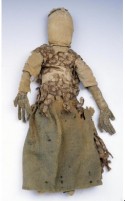
Bangwell Putt

Clarissa Field of Northfield, Massachusetts was given a handmade rag doll around 1770. She named her Bangwell Putt. What is heart-wrenching about this story is that Clarissa was blind, so it doesn’t matter that Bangwell has no facial features. She does however have well defined fingers, important for a child that relies heavily on the sense of touch. Dolls were beginning to be seen as useful playthings (for girls) helping to develop skills—dressing and undressing, sewing clothes— and convey information about what constituted appropriate attire. Girls could also practice caring for a doll as if it were an infant thereby learning what responsible motherhood involved. Clarissa had other dolls with similarly fanciful names: Pingo, Palica, Kimonarro, and Ebby Puttence. Sadly, Clarissa never married but she kept Bangwell until she died in her eighties. The doll is thought to be the oldest rag doll in North America.

The doll is held by the Pocumtuck Valley Memorial Association, Deerfield MA. See it here.

posted September 10th, 2015 by Janet, comments (0), CATEGORIES: Children, Clothes, Education

“The tremendous majesty of her tete . . . “

Molly Tilghman of Maryland wrote to her cousin Polly Pearce in January of 1789 describing the hat of one of woman and the hair of another at a ball she attended. Other tidbits of gossip too. Wicked and amusing.

Fain wou’d I dissect Miss [Anna] Garnett for your edification in the important point of fashion but a regular discription of so complicated a piece of work is more than I am equal to. Did you never of a rainy day, empty all your Drawers on the Bed, in order to set them to rights? If you can recollect the confus’d mixture of Ribbon, Gauze, flowers, Beads, Persian feathers and Lace, black and white, you will have the best idea I can give you of Miss Garnetts Hatt, such a Hoop and Handkerchief too was never seen on mortal Woman before. Upon my Life she was as complete a Carricature as any in our Hall. Mrs. Bordleys Head, without a Hat, was quite equal to the other. The tremendous majesty of her tete, will never leave my memory, which with the fabric which was erected on it made her almost as tall as myself. As her situation prevented her dancing I had a great deal of sweet converse with her. . . .
Can you imagine my dear Polly that I want to be reminded of my promis’d visit to Poplar Neck. Surely you know me better. If it depended on my inclination, soon wou’d you see me, but alas how few of our pursuits are directed by inclination. If I wanted an additional inducement to visit you, the alteration you tell me of wou’d be a great one. A succession of Beaux is pretty enough amusement in this dreary season and it wou’d be doubly agreeable to me from the powerful charm of novelty. If it were possible to exchange some of our Belles for some of your Beaux, the Circles of both wou’d be much improv’d by it. Could not your ingenuity contrive it ?
On new years day Miss Nevitt was married to Mr Steele after a three years Courtship. Her reign has been brilliant, and she has clos’d it in very good time, while her train was undiminish’d. It is a nice point for a Belle to know when to marry, and one in which they are very apt. She understood the matter.
Pray what kind of being is this Jones you mention ? Not much I fancy from your manner of passing him over. I dare say it is near morning, so I will creep up to bed as silently as possible. See what I suffer for your sake. Indeed you must write to me oftener. I will make the best returns in my power, both in quantity and quality. I am not sleepy, but exceedingly dim sighted. My best Love to all from
ever yours
M. T.

The letter can be found in the Maryland Historical Magazine Vol. 21, No. 3, 234-35.

posted September 7th, 2015 by Janet, comments (0), CATEGORIES: Courtship, Entertainments, Fashion, Marriage, Maryland, Pearce, Polly, Tilghman, Molly

“What shall we do with such a tribe of Girls?”

Continuing the correspondence between the Maryland cousins: Molly Tilghman sent a newsy letter to Polly Pearce at the end of January 1789.

Tho’ I got your Letter, my dear Polly, at eleven o’Clock this morning, and have been earnestly wishing to answer it ever since, yet this midnight hour is the first I have had to myself; from which you may judge whether my silence has proceeded from idleness, or constant employment. . . . I should not mind being fully employ’d all day if I cou’d sit up late at night, but from that I am cut off by Sister Nancy’s unconquerable aversion to any body’s coming into her room after she is asleep. This very Letter will cost me a Lecture, but I will incur it for the sake of justifying myself, and I hope this vindication, will make future ones unnecessary.
Sister N. has been a good deal at farly [Fairlee], and so often complaining when at home, that she has not divided the care of the family with me. T’is true Harriet has been very well, but you must know that the most favorable lying in brings a good deal of trouble with it, particularly at this season. For the first three Weeks I was not once out of the House. Indeed I was of such amazing consequence in the nursery, that nothing cou’d be done without me. You need not laugh Miss Polly, and accuse me of vanity. I can bring honorable testimony of my goods works, aye and of the necessity for them too. All this you will say is very true, but very dull also. I grant it, but you drag’d me into the detail by your uncharitable constructions of my silence.
Our little Caroline is a sweet Child*, tho’ the veryest fairy you ever saw. I have really seen a Doll as large, but she grows finely, and is extremely healthy. She is the picture of her Mother, from which you may judge of her pretensions to beauty. Her name is a whim of her fathers, who is hardly yet reconcil’d to his second Daughter. He was in as terrible a friz on the occasion, as if a title and vast estate had depended on the birth of a son. Poor Harriet has been so unlucky within the last fortnight, as to have a sore Breast, which made us very uneasy. It gather’d and broke in three days, and was as light as a thing of the kind cou’d be but in my life I never saw a Creature so terrified as she was. The idea of Lancets, Probes, and crooked scissors haunted her continually but happily none of them were necessary, and her Breast is now almost entirely well.

I am writing on without saying a word of Henny [Henrietta], though I am able to give such satisfactory accounts of her. The 15th of this Month she produc’d a Daughter**, (yes, another Daughter) with as little trouble as might be. What shall we do with such a tribe of Girls? She is call’d after my Ladyship. Not Molly, nor Polly, but Mary, and I have the additional honor of being her God Mother.

* the second child of Philemon Tilghman and his wife Harriet Milbanke
** Mary Tilghman,” the third child of Lloyd and Henrietta Maria Tilghman

Note the emphasis on having a male child. After this recounting of new births, Molly goes on (in the next post) to describe the hat of one of the women at the ball she attended the previous night.

The letter can be found in the Maryland Historical Magazine Vol. 21, No. 3, 231-233.

posted September 3rd, 2015 by Janet, comments (0), CATEGORIES: Childbirth, Illness, Maryland, Pearce, Polly, Tilghman, Molly

previous page · next page

   Copyright © 2026 In the Words of Women.